


介電質頻譜法

介電質頻譜法(Dielectric spectroscopy)也稱為電化學阻抗譜(Electrochemical Impedance Spectroscopy),屬於阻抗頻譜法(impedance spectroscopy)的一種,是量測不同頻率下介電質的介電特性變化[2][3][4][5]。這是以外部電場和樣品电偶极矩的交互作用為基礎,一般會用电容率表示。
介電質頻譜法也是確認電化學系統特性的實驗方法。此技術會量測系統在不同頻率範圍下的阻抗,包括其储能特性以及損失特性。介電質頻譜法所得的資料一般會用波德圖或奈奎斯特圖來圖示表示。
阻抗是電子系統對流過交流電(AC)抵抗的能力。被動元件組成的複數阻抗電子系統中,可能有能量消耗(電阻器)和能量儲存(电容器)的元件。若系統是純電阻性,則其抵抗交流電(AC)或直流電(DC)的方式是利用電阻。若材料或系統中有多個相(例如複合材料或是非均質材料),會有通用介電響應(universal dielectric response),介電質頻譜法可以看出阻抗(或其倒數,导纳)和施加交流電場頻率ω之間的關係。
幾乎所有物理-化學系統(像電化電池、質量束振盪器,甚至是生物的肌肉系統)都有能量消耗和能量儲存的特性。這就是介電質頻譜法要檢測的特性。
此技術的發展相當迅速,已廣泛用在許多科學領域中,例如燃料电池測試、生物分子交互作用,以及微結構的特性。介電質頻譜法可以看出電化學過程中的反應機制。不同的反應步驟會主導不同頻率的特性,可以由頻率響應看出限制速率的步驟。
介電機制
[编辑]
有許多種不同的介電機制,和所研究介質和外來電場的反應有關。每一種機制都有其特徵頻率,是其過程特徵時間的倒數。一般來說,介質機制可以分為弛豫(relaxation)過程和共振過程兩種。其中最常見的機制如下(從高頻到低頻排列):
電子極化
[编辑]此共振過程出現在中性原子裡,電場使原子核附近的電子密度出現位移。
此位移主要是因為回復力和電子力之間的平衡造成的。 理解電子極化時,可以假設原子是由點狀的原子核和周圍球狀,均勻密度的電子雲所組成。
原子極化
[编辑]原子極化出現在原子核對電場響應而重新定向。這是共振過程。原子極化是原子的本質,是外加電場的結果。電子極化是和電子密度有關,也是外加場的結果。原子極化會比電子極化要小很多。
偶極子弛豫
[编辑]偶極子弛豫(Dipole relaxation)源自永久偶極子和誘導偶極子因為電場而對齊,而對齊的極化因為熱噪音而受到干擾(使偶極向量不對齊場的方向),偶極子恢復需要的時間和局部黏度有關。這兩個因素和偶極子弛豫強烈的受温度和压强[6]影響,也受周圍的化學特性影響。
離子弛豫
[编辑]離子弛豫(Ionic relaxation)包括離子電導率弛豫,界面電荷弛豫以及空間電荷弛豫。離子電導率弛豫在低頻下佔主導地位,而且只會給系統帶來損耗。界面電荷弛豫出現在非均質系統裡的電荷載子被介面捕捉的時候。相關的效應是Maxwell-Wagner-Sillars極化,是電荷載子被內介電質邊界層所擋住(介觀尺度)或被外部電極擋住(巨觀尺度),因此造成電荷的分離。電荷可能會被分開相當的距離,因此造成介電損失,其數量級比分子擾動所造成的要大[2]。
介電質弛豫
[编辑]介電質弛豫(Dielectric relaxation)整體是因為外加交流場,造成偶極子運動(偶極子弛豫)和電荷運動(離子弛豫)的結果,其頻率會在102-1010 Hz。弛豫機制比共振電子轉態或是分子振動要慢,這些的頻率會超過1012 Hz。
原理
[编辑]穩態
[编辑]在氧化还原反应 R O + e裡(不考慮質量傳播的限制),其電流密度和電極過電位之間的關係可用巴特勒-福尔默方程來說明[7]: 其中 是交換電流密度,和是對稱係數。





和之間不是直線關係(圖1),因此氧化還原反應本身不是線性系統[8]。


動態特性
[编辑]法拉第阻抗
[编辑]在電化學電池中,電解質和電極介面的法拉第阻抗是介面上的接面電阻和電容。
假設巴特勒-福尔默方程正確描述氧化還原反應的動態特性:

氧化還原反應的動態特性可以表示為所謂的電荷轉移阻抗(charge transfer resistance),其公式如下:


電荷轉移阻抗的值會隨過電位而變化。在最簡單的範例中,法拉第阻抗會簡化成電阻,值得注意的是: 在時。


雙電層電容器
[编辑]

電極-電解質介面的特性類似電容,稱為是双电层電容器。圖2是氧化還原反應的等效電路,包括了雙電層電容以及電荷轉移電阻 。另一個常用來描述電化學雙電層的類比模型是常相位元件。

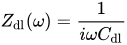
要計算此電路的阻抗,需要考慮電容的阻抗,其公式如下: 其中是弦波信號的角頻率(rad/s),且。


電路的阻抗如下:
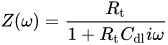
電路阻抗的尼奎斯特圖如圖3,是直徑為的半圓,最高點的角頻率為(圖3)。也可以用波德圖或是Black plan表示[9]


歐姆電阻
[编辑]歐姆電阻是和反應電極阻抗串聯,特性也在阻抗的尼奎斯特圖中。

通用介電響應
[编辑]在變動頻率ω的交流條件下,非勻質系統和複合材料會有通用介電響應,其中總導納有一段隨頻率冪律縮放區域[10]。

阻抗參數的量測
[编辑]繪製尼奎斯特圖可以利用恆電位儀[11]和阻抗分析仪(現代的恆電位儀通常也會附阻抗分析儀)繪製,其中可以讓使用者判斷電荷轉移電阻、雙電層電容器以及歐姆電阻。交換電流密度可以用量測時的氧化還原反應來求得。
若是比氧化還原更複雜的反應,或是考慮質量轉移限制的反應,其尼奎斯特圖會由多個圓弧組成。
應用
[编辑]介電質頻譜法已用在許多不同的領域中[12]。
在涂料和鍍膜產業中,此技術可以檢測塗層的品質[13][14],也可以檢測是否有出現腐蝕[15][16]。
介電質頻譜法用在許多生物传感器系統中,例如非標記定量,可以量測细菌濃度[17],也可以偵測危險致病菌,例如大腸桿菌 O157:H7[18]、沙門氏菌屬[19] 和酵母細胞[20][21]。
介電質頻譜法也用來分析許多不同的食品產品。像是評估食品-包裝交互作用[22]、牛奶成份的分析[23]、冰淇淋混合物凝固結束點的特性和確認[24][25]、肉熟成的量測[26]、水果熟成度和品質的檢測[27][28][29],以及橄欖油裡的游離酸度[30]。
在人體健康監測上,介電質頻譜法較為知的是生物電阻抗分析(BIA)[31],用來估測身體的各成分比例[32],以及一些人體參數,例如總體水分(total body water)和無脂肪質量(free fat mass)[33]。
介電質頻譜法也可以用來獲得電池的頻率響應,以及相對高溫下電催化系統的頻率響應[34][35][36]。
運作在微波範圍的生物醫學感測器,可以利用介電質頻譜法偵測某一頻率範圍內介電特性的變化,例如非侵入式連續血糖監控、[37][38]。IFAC資料庫可以用作人體組織介電特性的資料庫[39]。
在悬浊液等非均質系統中,介電質頻譜法可以用來監測粒子沈積的過程[40]。
相關條目
[编辑]- 介電吸收,超低頻的變化
- 介電損失
- 电化学
- 橢圓偏振技術
- Green–Kubo關係
- 誘導極化(IP)
- 克拉莫-克若尼關係式
- 線性響應函式
- 恆電位儀
- 頻譜誘導極化(SIP)
參考資料
[编辑]- ^ From the Dielectric spectroscopy page of the research group of Dr. Kenneth A. Mauritz.
- ^ 2.0 2.1 Kremer F., Schonhals A., Luck W. Broadband Dielectric Spectroscopy. – Springer-Verlag, 2002.
- ^ Sidorovich A. M., Dielectric Spectrum of Water. – Ukrainian Physical Journal, 1984, vol. 29, No 8, p. 1175-1181 (In Russian).
- ^ Hippel A. R. Dielectrics and Waves. – N. Y.: John Wiley & Sons, 1954.
- ^ Volkov A. A., Prokhorov A. S., Broadband Dielectric Spectroscopy of Solids. – Radiophysics and Quantum Electronics, 2003, vol. 46, Issue 8, p. 657–665.
- ^ Floudas G., Paluch, M., Grzybowski A., Ngai K. L. Molecular Dynamics of Glass-Forming Systems - Effects of Pressure. Springer-Verlag, 2011.
- ^ Okajima, Yoshinao; Shibuta, Yasushi; Suzuki, Toshio. A phase-field model for electrode reactions with Butler–Volmer kinetics. Computational Materials Science. 2010, 50 (1): 118–124. doi:10.1016/j.commatsci.2010.07.015.
- ^ Linear vs. non-linear systems in impedance measurements 互联网档案馆的存檔,存档日期December 5, 2008,.
- ^ Potentiostat stability mystery explained (PDF). [2011-11-08]. (原始内容 (PDF)存档于2013-10-23).
- ^ Zhai, Chongpu; Hanaor, Dorian; Gan, Yixiang. Universality of the emergent scaling in finite random binary percolation networks. PLOS ONE. 2017, 12 (2). Bibcode:2017PLoSO..1272298Z. PMC 5312937
 . PMID 28207872. doi:10.1371/journal.pone.0172298 . 已忽略未知参数
|article-number=(帮助) - ^ Impedance, admittance, Nyquist, Bode, Black, etc. 互联网档案馆的存檔,存档日期July 21, 2011,.
- ^ Lasia, A. Electrochemical Impedance Spectroscopy and Its Applications. In "Modern aspects of electrochemistry", volume 32. : 143–248.
- ^ McIntyre, J.M.; Pham, H.Q. Electrochemical impedance spectroscopy; a tool for organic coatings optimizations. Progress in Organic Coatings. 1996, 27 (1–4): 201–207. doi:10.1016/0300-9440(95)00532-3.
- ^ Amirudin, A.; Thieny, D. Application of electrochemical impedance spectroscopy to study the degradation of polymer-coated metals. Progress in Organic Coatings. 1995, 26 (1): 1–28. doi:10.1016/0300-9440(95)00581-1.
- ^ Bonora, P.L.; Deflorian, F.; Fedrizzi, L. Electrochemical impedance spectroscopy as a tool for investigating underpaint corrosion. Electrochimica Acta. 1996, 41 (7–8): 1073–1082. doi:10.1016/0013-4686(95)00440-8.
- ^ Rammelt, U.; Reinhard, G. Application of electrochemical impedance spectroscopy (EIS) for characterizing the corrosion-protective performance of organic coatings on metals. Progress in Organic Coatings. 1992, 21 (2–3): 205–226. doi:10.1016/0033-0655(92)87005-U.
- ^ Maalouf, R.; Fournier-Wirth, C.; Coste, J.; Chebib, H.; Saikali, Y.; Vittori, O.; Errachid, A.; Cloarec, J.P.; Martelet, C.; Jaffrezic-Renault, N. Label-Free Detection of Bacteria by Electrochemical Impedance Spectroscopy: Comparison to Surface Plasmon Resonance. Analytical Chemistry. 2007, 79 (13): 4879–4886. PMID 17523594. S2CID 38589225. doi:10.1021/ac070085n.
- ^ Ruan, C.; Yang, L.; Li, Y. Immunobiosensor Chips for Detection of Escherichia coli O157:H7 Using Electrochemical Impedance Spectroscopy. Analytical Chemistry. 2002, 74 (18): 4814–4820. PMID 12349988. S2CID 2068234. doi:10.1021/ac025647b.
- ^ Nandakumar, V.; La Belle, J.T.; Reed, J.; Shah, M.; Cochran, D.; Joshi, L.; Alford, T.L. A methodology for rapid detection of Salmonella typhimurium using label-free electrochemical impedance spectroscopy. Biosensors & Bioelectronics. 2008, 24 (4): 1039–1042. PMID 18678481. doi:10.1016/j.bios.2008.06.036.
- ^ Soley, A.; Lecina, M.; Gamez, X.; Cairo, J.J.; Riu, P.; Rosell, X.; Bragos, R.; Godia, F. On-line monitoring of yeast cell growth by impedance spectroscopy. Journal of Biotechnology. 2005, 118 (4): 398–405. PMID 16026878. doi:10.1016/j.jbiotec.2005.05.022.
- ^ Chen, H.; Heng, C.K.; Puiu, P.D.; Zhou, X.D.; Lee, A.C.; Lim, T.M.; Tan, S.N. Detection of Saccharomyces cerevisiae immobilized on self-assembled monolayer (SAM) of alkanethiolate using electrochemical impedance spectroscopy. Analytica Chimica Acta. 2005, 554 (1–2): 52–59. doi:10.1016/j.aca.2005.08.086.
- ^ Hollaender, J. Rapid assessment of food/package interactions by electrochemical impedance spectroscopy (EIS). Food Additives & Contaminants. 2009, 14 (6–7): 617–626. PMID 9373526. doi:10.1080/02652039709374574.
- ^ Mabrook, M.F.; Petty, M.C. Effect of composition on the electrical conductance of milk. Journal of Food Engineering. 2003, 60 (3): 321–325. doi:10.1016/S0260-8774(03)00054-2.
- ^ Grossi, Marco; Lanzoni, Massimo; Lazzarini, Roberto; Riccò, Bruno. Automatic ice-cream characterization by impedance measurements for optimal machine setting (PDF). Measurement. August 2012, 45 (7): 1747–1754. Bibcode:2012Meas...45.1747G. S2CID 110783818. doi:10.1016/j.measurement.2012.04.009.
- ^ Grossi, M.; Lazzarini, R.; Lanzoni, M.; Riccò, B. A novel technique to control ice cream freezing by electrical characteristics analysis (PDF). Journal of Food Engineering. October 2011, 106 (4): 347–354. doi:10.1016/j.jfoodeng.2011.05.035.
- ^ Damez, J.L.; Clerion, S.; Abouelkaram, S.; Lepetit, J. Beef meat electrical impedance spectroscopy and anisotropy sensing for non-invasive early assessment of meat ageing. Journal of Food Engineering. 2008, 85 (1): 116–122. doi:10.1016/j.jfoodeng.2007.07.026.
- ^ Rehman, M.; Abu Izneid, J.A.; Abdullha, M.Z.; Arshad, M.R. Assessment of quality of fruits using impedance spectroscopy. International Journal of Food Science & Technology. 2011, 46 (6): 1303–1309. S2CID 23053716. doi:10.1111/j.1365-2621.2011.02636.x.
- ^ Harker, F.R.; Forbes, S.K. Ripening and development of chilling injury in persimmon fruit: An electrical impedance study. New Zealand Journal of Crop and Horticultural Science. 1997, 25 (2): 149–157. doi:10.1080/01140671.1997.9514001 .
- ^ Bauchot, A.D.; Harker, F.R.; Arnold, W.M. ). The use of electrical impedance spectroscopy to assess the physiological condition of kiwifruit. Postharvest Biology and Technology. 2000, 18 (1): 9–18. doi:10.1016/S0925-5214(99)00056-3.
- ^ Grossi, M.; Di Lecce, G.; Gallina Toschi, T.; Riccò, B. A novel electrochemical method for olive oil acidity determination (PDF). Microelectronics Journal. December 2014, 45 (12): 1701–1707. S2CID 13168066. doi:10.1016/j.mejo.2014.07.006.
- ^ Kyle, U.G.; Bosaeus, I.; De Lorenzo, A.D.; Deurenberg, P.; Elia, M.; Gomez, J.M.; Heitmann, B.L.; Kent-Smith, L.; Melchior, J.C.; Pirlich, M.; Scharfetter, H.; Schols, A.; Pichard, C. Bioelectrical impedance analysis—part I: review of principles and methods. Clinical Nutrition. 2004, 23 (5): 1226–1243. PMID 15380917. S2CID 21000697. doi:10.1016/j.clnu.2004.06.004.
- ^ Tengvall, M.; Ellegard, L.; Malmros, V.; Bosaeus, N.; Lissner, L.; Bosaeus, I. Body composition in the elderly: Reference values and bioelectrical impedance spectroscopy to predict total body skeletal muscle mass. Clinical Nutrition. 2009, 28 (1): 52–58. PMID 19010572. doi:10.1016/j.clnu.2008.10.005.
- ^ Van Loan, M.D.; Withers, P.; Matthie, J.; Mayclin, P.L. Use of Bioimpedance Spectroscopy to Determine Extracellular Fluid, Intracellular Fluid, Total Body Water, and Fat-Free Mass. Chapter in Human Body Composition, Volume 60 of the series Basic Life Sciences. : 67–70.
- ^ M. Radtke, C. Hess, Easy-Made Setup for High-Temperature (Up to 1100 °C) Electrochemical Impedance Spectroscopy, J. of Materi Eng and Perform (2022). https://doi.org/10.1007/s11665-022-06653-3
- ^ Macdonald, Digby D. Reflections on the history of electrochemical impedance spectroscopy. Electrochimica Acta. 2006, 51 (8–9): 1376–1388. doi:10.1016/j.electacta.2005.02.107.
- ^ Dokko, K.; Mohamedi, M.; Fujita, Y.; Itoh, T.; Nishizawa, M.; Umeda, M.; Uchida, I. Kinetic Characterization of Single Particles of LiCoO2 by AC Impedance and Potential Step Methods. Journal of the Electrochemical Society. 2001-05-01, 148 (5): A422–A426. Bibcode:2001JElS..148A.422D. ISSN 0013-4651. doi:10.1149/1.1359197 (英语).
- ^ Choi, H.; Naylon, J.; Luzio, S.; Beutler, J.; Birchall, J.; Martin, C., and Porch, A., "Design and in-vitro interference test of microwave noninvasive blood glucose monitoring sensor," IEEE Trans. Microw. Theory Techn., vol. 63, no. 10, pp. 3016-3025, Oct. 2015. https://doi.org/10.1109/TMTT.2015.2472019
- ^ Choi, H.; Luzio, S.; Beutler, J.; and Porch, A., "Microwave noninvasive blood glucose monitoring sensor: Human clinical trial results," in 2017 IEEE MTT-S International Microwave Symposium (IMS) Proceedings, pp. 876-879, Honolulu, HI, USA, 4–9 June 2017. https://doi.org/10.1109/MWSYM.2017.8058721
- ^ D.Andreuccetti, R.Fossi and C.Petrucci. An Internet resource for the calculation of the dielectric properties of body tissues in the frequency range 10 Hz - 100 GHz. Based on data published by C.Gabriel et al. in 1996. IFAC-CNR, Florence (Italy). 1997.
- ^ Doppelhammer, Nikolaus; Pellens, Nick; Kirschhock, Christine E.A.; Jakoby, Bernhard; Reichel, Erwin K. Using Moving Electrode Impedance Spectroscopy to Monitor Particle Sedimentation. IEEE Sensors Journal. 2020, 21 (8): 9636–9641. ISSN 1530-437X. doi:10.1109/JSEN.2020.3004510 .
