

圣雄甘地

 「甘地」重定向至此。关于其他用法,请见「甘地 (消歧义)」。
 |


| 聖雄 聖雄甘地(Mohandas Gandhi) | |
|---|---|
 甘地(1931年) | |
| 出生 | 莫罕達斯·卡拉姆昌德·甘地(Mohandas Karamchand Gandhi) 1869年10月2日 波爾本達, 卡提亞瓦署 |
| 逝世 | 1948年1月30日(78歲) 印度自治领新德里 |
| 死因 | 遇刺 |
| 纪念建筑 | |
| 别名 | Bāpū (父親), 國父(Rāṣṭrapitā) |
| 母校 | 倫敦城市法學院 |
| 职业 |
|
| 活跃时期 | 1893–1948年 |
| 知名于 | |
| 政党 | 印度國民大會黨 (1920–1934年) |
| 配偶 | 卡司杜巴·甘地 (1883年结婚—1944年丧偶) |
| 儿女 |
|
| 父母 | |
| 亲属 | 甘地家族 |
| 印度國民大會黨主席 | |
| 任期 1924年12月 – 1925年4月 | |
| 前任 | 阿布·卡拉姆·阿扎德 |
| 继任 | 薩洛季妮·奈都 |
| 签名 | |
 | |
莫罕達斯·卡拉姆昌德·甘地 [c](古吉拉特語:મોહનદાસ કરમચંદ ગાંધી,印地語:मोहनदास करमचंद गांधी,英語:Mohandas Karamchand Gandhi ,1869年10月2日—1948年1月30日)[d][3] ,尊稱聖雄甘地(印地語:महात्मा गांधी),印度國父,是一位印度律師、思想家、反殖民運動家和政治倫理學家,他採用非暴力抵抗的方式,成功領導印度從英國統治下贏得獨立(參見印度獨立運動)。他啟發世界各地的民權和自由運動。於1914年在南非,首次有人用梵語中的敬語Mahātmā(意為"偉大的靈魂"或"值得尊敬的")稱他,之後廣為世界各地使用。[4]
甘地在今日古吉拉特邦,一個靠海,信仰印度教的家庭出生及長大,之後在英國倫敦的內殿律師學院接受法律訓練,並在22歲時獲得律師資格。他回印度後,經歷兩年而未能成功開展律師業務,於1893年移居南非,為一位印度商人處理訴訟事務。他在南非居住21年,甘地在此首次採用非暴力抵抗的方式開展民權運動。甘地在1915年(45歲)返回印度,並很快開始組織佃農、自耕農和城市工人,以與歧視和過高的土地稅對抗。
甘地於1921年接下印度國民大會黨的領導權後,發動全印度運動,以減輕貧困、擴展婦女權利、倡導宗教與民族之間和睦相處、消除不可接觸者階層(達利特),以及最重要的是爭取印度的自治(即自決權)。甘地身著手工紡車編織的短托蒂,以此表明他認同印度的農村貧困人口。他開始在自給自足的社區生活,吃簡單的食物,並進行長時間禁食,作為內省和政治抗議的手段。甘地將反殖民民族主義帶給普通印度民眾。他領導人民挑戰英國強加的鹽稅,於1930年發起步行400公里(250英里)的食鹽進軍,並在1942年發出"[英國]退出印度(Quit India)"的呼籲。他曾在南非和印度多次被捕入獄,服刑多年。
甘地基於建立一個宗教多元主義的獨立印度國家願景,在1940年代初受到穆斯林民族主義的挑戰,後者要求在英屬印度境內為穆斯林建立一個單獨的家園。英國於1947年8月批准印度獨立,但英屬印度則被分裂成兩個自治領:印度(以印度教徒為多數)和巴基斯坦(以穆斯林為多數)。當眾多流離失所的印度教徒、穆斯林和錫克教徒被迫遷移,前往他們的新國家,宗教暴力隨之爆發,尤其是在旁遮普和孟加拉地區。甘地沒參加官方的慶祝獨立活動,而是探訪受暴亂影響的地區,試圖緩解困境。他在接下來的幾個月裡進行幾次絕食以阻止宗教暴力。最後一次絕食於1948年1月12日在德里開始,當時他已78歲。一些印度教徒開始認為甘地在維護巴基斯坦和印度穆斯林方面過於堅決。在這類人之中,有一位來自印度西部浦納的激進印度教民族主義者 - 南度藍姆·高德西,他於1948年1月30日在德里的一場跨信仰的祈禱會上,向甘地的胸部連開三槍,將其刺殺。
印度將甘地的生日 - 10月2日,定為甘地誕辰日,作為國定紀念日,並在世界各地被定為國際非暴力日。甘地被印度共和國尊為國父。在印度民族主義運動期間及之後的幾十年裡,他也被普遍稱為Bapu,這是一個暱稱,大致為"父親"的意思。
早年生活與家庭背景
[编辑]父母
[编辑]甘地的父親,卡拉姆昌德·甘地(1822–1885年),曾擔任波爾班達土邦的行政首長。[5][6]他的家族起源於當時朱納格特土邦內的庫蒂耶納村。卡拉姆昌德最初只是波爾班達土邦行政部門的一名文書,且他只受過基礎教育,但因能力而在日後成為一位稱職的行政首長。[7]
卡拉姆昌德在任職期間曾結過四次婚。他最初的兩任妻子在各生下一個女兒後早逝,而他的第三段婚姻沒生子女。卡拉姆昌德於1857年取得第三任妻子的同意後再婚,娶名為普特利巴伊(Putlibai,1844–1891年)的女子為妻,普特利巴伊同樣來自朱納格特土邦,[7]出身於一個信仰帕拉那彌派的家庭。[8][9][10]卡拉姆昌德和普特利巴伊育有四個子女:長子拉克什米達斯(Laxmidas,約1860–1914年)、女兒拉利亞特貝恩(Raliatbehn,1862–1960年)、次子卡爾桑達斯(Karsandas,約1866–1913年),莫罕達斯·卡拉姆昌德·甘地為三子,[11]甘地於1869年10月2日在波爾本達出生,此地是卡提亞瓦半島上的一個濱海城鎮,當時隸屬於英屬印度卡提亞瓦署(於孟買管轄區)的波爾班達土邦。[12]
甘地的父親於1874年離開波爾班達土邦,前往規模較小的拉傑科特土邦(Rajkot),他在那裡成為統治者Thakur Sahib的顧問。拉傑科特土邦的名氣不如波爾班達土邦,但因英國區域政治署(British regional political agency)設在那裡,為擔任土邦的行政首長帶來一定程度的安全保障。[13]卡拉姆昌德於1876年升任拉傑科特土邦的行政首長,而波爾班達土邦行政首長一職則由他的兄弟圖爾西達斯(Tulsidas)繼任。卡拉姆昌德的家人隨後搬到拉傑科特土邦與他團聚。[13]全家於1881年搬進現被稱為卡巴·甘地家族故居的宅第居住。[14]
童年時期
[编辑]
甘地的姐姐拉利亞特(Raliat)描述甘地童年時期是"非常調皮,不是在玩耍就是到處閒逛。他最喜歡的消遣之一是扭狗的耳朵" 。[15]印度古典文學,特別是沙拉瓦那·庫瑪拉的故事和哈里什昌德拉王的故事對甘地的童年產生巨大影響。甘地在自傳中提到,這些故事在他的心靈中留下不可磨滅的印象。甘地寫道:"它一直縈繞著我,我肯定無數次地將自己扮演成哈里什昌德拉王"。甘地早期將真理與愛視為最高價值觀的自我認同,源於這些史詩中人物的啟發。[16][17]
甘地家族的宗教背景為兼收並蓄。甘地出生於一個古吉拉特信仰印度教的巴尼亞種姓家庭。[18][19]甘地父親的巴尼亞種姓屬於吠舍瓦爾那(階級)。[20]他的母親來自中世紀基於對黑天的虔誠而發展起來的帕拉那彌派,[21][22]這個教派的宗教典籍包括《薄伽梵歌》、《薄伽梵往世書》,以及一套包含14篇經文的彙編,這個派別相信這些經文包含《吠陀經》、《古蘭經》和《聖經》的精髓。[22][23]甘地母親是一位極為虔誠的女性,而他深受母親的影響,"她如果不做日常禱告就不會進食... 她會許下最困難的誓願,且堅定遵守。對她來說,連續兩三次禁食根本是件小事" 。[24]
甘地九歲時,進入拉傑科特土邦離他家不遠的學校,學習算術、歷史、古吉拉特語和地理等基礎知識。[13]十一歲時進入當地的阿爾弗雷德高中 (Alfred High School) 。[25]他的學業成績普通,雖然贏得一些獎項,但害羞、拙於言辭,又對體育遊戲不感興趣。他唯一的夥伴是書本和學校課程 。[26]
婚姻生活
[编辑]13歲的甘地於1883年5月與14歲的卡斯圖巴伊·戈庫爾達斯·卡帕迪亞(Kasturbai Gokuldas Kapadia,通常被簡稱為卡斯圖巴"Kasturba",暱稱為"Ba")經由包辦婚姻結為連理,[27]這是當時的習俗。他為此婚姻而耽誤一年的上學時間,但後來透過加速學習來補足。[28]甘地的婚禮是一場聯合婚禮,他的兄弟和堂兄也同時結婚。甘地回憶起他們結婚的那一天,曾說:"由於我們對婚姻了解不多,對我們而言只表示穿新衣、吃甜食和與親戚玩耍。"根據當時盛行的傳統,這名年輕新娘在接下來的幾年裡,多數時候是住在娘家,與丈夫分開居住。[29]
甘地在多年後於其著作中帶著懊悔,描述他對年輕妻子的淫慾情感:"即使在學校時,我也會想起她,夜晚降臨和隨之的相會想法一直縈繞著我。"甘地後來回憶道,他對卡斯圖巴感到嫉妒和具強烈的佔有慾,例如當她與女姓朋友一起去寺廟時,以及他對她充滿性的慾望。[30]

甘地的父親卡拉姆昌德在1885年底去世。[32]甘地在父親臨終前僅幾分鐘卻離開父親的病榻去陪伴妻子。甘地在幾十年後寫道:"如果動物般的激情沒蒙蔽我雙眼,我就能在父親生命的最後時刻陪著他。[33]甘地的妻子在他16歲時為他生下第一個孩子,但在幾天後夭折。這前後兩次死亡讓甘地感到痛苦萬分。[32]甘地夫婦之後又生有四個孩子,全部是男生:哈里拉爾(Harilal),生於1888年、馬尼拉爾(Manilal),生於1892年、拉姆達斯(Ramdas),生於1897年,以及德夫達斯(Devdas),生於1900年。[27]
18歲的甘地於1887年11月從亞美達巴德的一所高中畢業。[34]他於1888年1月進入包那加爾土邦的薩馬爾達斯學院就讀,這是當時該地區唯一授予學位的高等教育機構。然而甘地隨後卻輟學,返回家中。[35] 甘地的課外教育,因接觸古吉拉特語文學而更加豐富,特別是納爾馬德(古吉拉特語詩人及劇作家)和戈瓦爾漢拉姆·特里帕蒂(古吉拉特語小說家)等改革家的作品。這些作品提醒古吉拉特人關注自身的錯誤和弱點,例如對宗教教條主義的迷信。[36]
倫敦三年
[编辑]研讀法律
[编辑]
甘地從孟買的學院輟學後,[37]一位婆羅門祭司兼家族朋友 - 馬夫吉·戴夫·喬希吉(Mavji Dave Joshiji)建議甘地和他的家人,他該考慮去倫敦學習法律。[35][38]甘地的妻子卡斯圖巴於1888年7月生下他們第一個存活的孩子 - 哈里拉爾(Harilal)。[39]甘地的母親對甘地遠走他鄉、離開妻兒而感到不安。甘地的叔叔圖爾西達斯(Tulsidas)也試圖勸阻,但甘地心意已決。為說服他的妻子和母親,甘地在母親面前立下誓言,承諾他將戒除肉食、酒精和女色。甘地的兄長拉克什米達斯當時已是一名律師,他支持甘地前往倫敦的留學計畫,並表示願意資助。甘地的母親最終也同意,並給予祝福。[35][40]
18歲的甘地於1888年8月10日離開波爾班達土邦,先前往孟買。一份報導他在拉傑科特土邦母校告別儀式的當地報紙指出,甘地是卡提亞瓦半島地區第一位前往英國參加律師考試的巴尼亞種姓 。[36]當甘地等待前往倫敦的船班時,他發現自己惹怒孟買的巴尼亞種姓群眾。[36]原因是當他抵達孟買後,暫住在當地的巴尼亞人社區,社區的長老們警告甘地,英國將誘惑他違背自己的宗教,並改採西方的飲食方式。甘地告知他們他對母親的承諾以及她給予的祝福,但仍被逐出社區。甘地對此並不在意,於9月4日從孟買啟程,由大哥送行。[37][39]甘地進入倫敦大學學院就讀,並於1888年至1889年間修讀亨利·莫利先生教授的英國文學課程。[41]

甘地也在內殿律師學院附屬的倫敦城市法學院註冊,目的是成為一名出庭律師。[38]甘地抵達倫敦時仍保有害羞和內向的特質,但他加入一個公開演講練習小組,盡量將羞怯克服,以便將來能以法律工作為業。[42]
甘地對倫敦貧困碼頭區社區的福祉表現出濃厚的興趣。倫敦於1889年爆發一場激烈的勞資糾紛,碼頭工人為要求更好的工資和工作條件而發動罷工,海員、造船工人、工廠女工和其他人也加入,以作聲援。罷工最終取得成功,部分歸功於樞機主教亨利·愛德華·曼寧居中調解。而促使甘地和一位印度朋友特地拜訪這位樞機主教,對他為勞方的幫助表達謝意。[43]
素食主義與委員會工作
[编辑]
甘地對母親許下的誓言影響他在倫敦的生活。他曾嘗試採納"英式"習俗,包括學習跳舞。[44]然而他不喜歡女房東提供的清淡素食,經常感到飢餓,直到他在倫敦僅有少數的幾家素食餐廳中找到一家,問題才獲解決。甘地受英國作家亨利·索爾特著作的影響而加入倫敦素食協會,並在協會主席兼贊助人阿諾德·希爾斯的主持下被選為執行委員會成員。[45]他在委員會期間的一項成就是為協會建立卑士窩打分會。[46]甘地遇到的一些素食主義者是證道學會的成員,學會成立於1875年,目的為促進普世博愛,並致力於研究佛教和印度教文獻。他們鼓勵甘地與他們一起閱讀《薄伽梵歌》的譯本和原著。[45]
甘地與希爾斯之間保持友好且合作順暢的關係,但兩人在對委員會成員托馬斯·艾林森(一位醫生)是否應留在倫敦素食協會的問題上看法有異。這次分歧是已知甘地首次挑戰權威的例子,他雖然生性害羞,且性格上不傾向於對抗。艾林森一直在推廣新出現的節育方法,但希爾斯不贊同此做法,認為它破壞公共道德。他認為素食主義是一場道德運動,因此艾林森不應再留在倫敦素食協會中。甘地雖然同意希爾斯關於節育具危險性的觀點,但他也捍衛艾林森持有不同意見的權利。[47]對甘地來說,挑戰希爾斯有其困難:希爾斯比他年長1歲,且口才便給。希爾斯是素食協會的贊助人,也是工業巨擘,他擁有的泰晤士鐵工及造船公司在倫敦東區僱用超過6,000人。希爾斯還是一位卓越的運動員,後來創立西漢姆聯足球俱樂部。
甘地在其於1927年出版的《自傳》第一卷中寫道:
這個問題讓我深感興趣……我對希爾斯先生及其慷慨大方非常敬重。但我認為僅因為一個人拒絕將清教徒式的道德觀視為協會的宗旨之一,就將其逐出協會,完全不恰當。[47]
委員會提出罷免艾林森的動議,並進行辯論和投票。甘地的羞怯成為他在會議上為艾林森辯護的障礙。雖然甘地已將其觀點寫在紙上,但因羞怯而無法宣讀其論點,因此主席希爾斯要求另一位委員會成員代他讀出。委員會中有些成員同意甘地的觀點,但投票的結果是艾林森被開除會籍。希爾斯和甘地間並沒因此產生嫌隙,希爾斯在為甘地返回印度舉行的協會告別晚宴上,還提議為甘地舉杯致意。[48]
獲得律師資格
[编辑]甘地在1891年6月(22歲)獲得律師資格,隨後離開倫敦返回印度。此時他才知道母親在他留學期間已過世,而家人為不讓他分心而將消息隱瞞。[45]他嘗試在孟買從事律師業務,但因為他無法克服在法庭上詰問證人的心理障礙而以失敗告終。他返回拉傑科特土邦,以為訴訟當事人起草訴訟書,賺取微薄的生活費用,但又因與英國官員山姆·桑尼(Sam Sunny)發生衝突,連此業務也被迫停止。[45][46]
一位卡提亞瓦土邦的穆斯林商人達達·阿卜杜拉(Dada Abdullah)於1893年聯繫甘地。阿卜杜拉在南非擁有一家大型、業務繁忙的航運公司。他在約翰尼斯堡的遠房表親需要一位律師,他們希望聘請一位卡提亞瓦半島出身的人。甘地詢問這份工作的薪酬,對方提出給予總薪水105英鎊(約合2023年的4,143美元)外加旅費。甘地接受這份工作,因為他知道這地方至少是在南非納塔爾殖民地 - 同樣是大英帝國的一部分,且聘用期間至少是一年。[46][49]
在南非成為民權行動者(1893–1914年)
[编辑]
23歲的甘地於1893年4月乘船前往南非,擔任阿卜杜拉表弟的律師。[49][50]甘地在南非前後度過21年的時間,他於其間發展出自己的政治觀點、倫理原則和政治手腕。[51][52]甘地曾於1902年短暫返回印度,目的是動員支持在南非印度裔移民的福利工作。[53]
甘地抵達南非後,立即因他的膚色和背景而受到歧視。[54]甘地不准與歐洲乘客一同坐在驛站馬車內,而被要求坐在駕車者旁邊的地板上,當他拒絕時,遭到毆打。而在其他地方,他因膽敢走近一棟房子而被踢進水溝。另一次是因為他拒絕離開頭等車廂,而在彼得馬利茲堡被趕下火車。[37][55]甘地為此整夜坐在火車站,因寒冷而顫抖,思考是應該返回印度,還是該抗議以爭取自己的權利。[55]甘地最終選擇抗議,而被允許在第二天搭上火車。[56]在另一起事件中,德班法院的一名地方法官命令甘地摘下他的頭巾,而他拒絕。[37]印度人在當時不被允許在南非的公共人行道上行走。甘地曾被一名警察在沒有警告的情況下,從人行道上踢到街上。[37]
根據美國歷史學家阿瑟·赫爾曼的說法,當甘地抵達南非時,他認為自己是"首先是英國人,其次才是印度人(即英國人的身份優於印度人)" 。[57] [55]然而甘地親身經歷和觀察到關於英國人對他及其他印度同胞的偏見,讓他非常困擾。甘地認為這是種羞辱,他很難理解有些人如何在行使這種不人道的行為中會感受到榮譽、優越感或是快樂。[55]甘地開始質疑他的國人在大英帝國中的地位。[58]
阿卜杜拉介紹甘地到南非處理的法律案件在1894年5月結案。[59]甘地準備返回印度,當地的印度社群為他舉辦告別會。這場告別會隨即轉變為一個工作委員會,以策劃抵抗納塔爾殖民地政府一項新的歧視性提案,而導致甘地延長他原本計劃在南非停留的時間。甘地計劃協助印度移民反對一項剝奪他們投票權的法案,當時這項權利被提議成為歐洲人的專屬。他請求英國殖民地事務大臣約瑟夫·張伯倫重新考慮在該法案上的立場 。[51]雖然甘地無法阻止法案通過,但他發起的運動成功地引起人們對南非印度人冤屈的關注。他於1894年協助成立納塔爾殖民地印度人國民大會黨(Natal Indian Congress),[46][56]並透過這個組織將南非的印度社群塑造成一股統一的政治力量。當甘地於1897年1月前往德班,在登陸時遭遇一群白人定居者組成的暴徒襲擊。[60]甘地最終在警察局長妻子的幫助下才能脫困。然而甘地拒絕起訴暴徒中的任何成員。[46]

甘地於1900年在第二次布爾戰爭期間自願組建一支擔架隊,即納塔爾印度人救護隊(Natal Indian Ambulance Corps)。根據阿瑟·赫爾曼的說法,甘地希望打破英國殖民地的刻板印象,即印度教徒與穆斯林的"尚武"不同,不適合參與涉及危險和費力,具"男子氣概"的活動。[61]甘地動員1,100名印度志願者,協助英軍作戰部隊對抗布爾人。他們經過訓練並獲得醫療認證後在前線服務。他們在第二次科倫索戰役中是白人志願救護隊的輔助部隊。在斯皮恩科普戰役中,由於地形過於崎嶇,救護車無法行駛,甘地和他的擔架隊員須移往前線,將傷者抬行數英里後再送到野戰醫院。甘地和另外37名印度人因此而獲頒女王南非勳章。[62][63]

川斯瓦殖民地政府於1906年頒佈一項新法案,強制殖民地的印度和華人人口進行登記。該法律要求亞洲人接受指紋註冊,並隨身攜帶身份證明文件,官員可隨時要求查驗。[64]歷史學家指出,甘地的抵抗因此也是對把印度人即生物辨識為犯罪嫌疑分子的的一種抗議。[64]甘地最初接受自願註冊,作為一種信任的姿態,但後來意識到一旦指紋被記錄,個人就失去撤回同意的權利。這隨後塑造甘地將薩提亞格拉哈(Satyagraha,梵語,義為堅持真理)理解為捍衛尊嚴和個人自主權的理念。[64]甘地在同年9月11日於約翰尼斯堡舉行的一次大規模抗議集會上,首次採用他當時仍在發展中的方法 - 堅持真理,或稱非暴力抵抗。[65]根據加拿大歷史學家安東尼·帕雷爾的說法,俄國小說家、哲學家列夫·托爾斯泰與甘地間,從前者所寫的致印度教徒的一封信中提及坦米爾道德文獻之後,甘地開始閱讀,而受到影響。[66][67]甘地敦促印度人違抗這項川斯瓦殖民地政府的新法律,並承受因此而來的懲罰。他的抗議思想、說服技巧和公共關係在此時已開始成形。甘地於1915年將此思想帶回印度。[68][69]
歐洲人、印度人與非洲人
[编辑]甘地在南非期間,將注意力集中在印度人和非洲人身上。甘地最初對政治並不感興趣,但情況在他遭受歧視和欺凌之後發生變化 - 例如,他曾因膚色而被一名白人火車職員趕下車。在南非經歷幾次與白人的類似事件後,甘地的思想和關注點發生轉變,他感到必須抵抗並"爭取權利"。甘地透過成立納塔爾印度人國大黨而進入政界。[70]根據兩位南非學者和作家阿什溫·德賽(Ashwin Desai)和古拉姆·瓦赫德(Goolam Vahed)的說法,甘地對種族主義的看法在某些情況下會引發爭議。他在南非從一開始就遭受迫害。就像其他有色人種一樣,白人官員對待他就像對待其他有色人種一樣,甘地的權利受到剝奪,新聞界和街上的人欺凌他,把"寄生蟲"、"半野蠻人"、"毒瘤"、"骯髒的苦力"、"黃種人"等侮辱性稱號加在他身上。人們甚至會朝他吐口水,以表達他們的種族仇恨。[71]

甘地在南非期間,先是專注於印度人所遭受的種族迫害,之後才開始關注針對非洲人的種族主義。德賽和瓦赫德指出,甘地的行為在某些情況下會主動迎合種族刻板印象,並間接參與對非洲人的剝削。[71]甘地在1896年9月的一次演講中抱怨說,英屬南非殖民地的白人"正在將印度人貶低到未開化的卡菲爾人的水平"。[72]學者們引用此例作為證據,表明甘地在當時對待印度人和南非黑人的態度有所不同。[71]美國歷史學家亞瑟·赫爾曼提供的另一例是甘地在24歲時(1895年)為納塔爾殖民地議會準備一份法律摘要,目的在爭取印度人的投票權。甘地引用種族歷史和歐洲東方學家的觀點,即"盎格魯-撒克遜人與印度人起源於相同的雅利安人血統,或者更確切地說是使用印歐語系的民族",並主張不應將印度人與非洲人歸為一類。[59]
甘地和他的同僚們在多年後以護士的身份服務並幫助非洲人,並反對種族主義。諾貝爾和平獎得主納爾遜·曼德拉就是對甘地在非洲反對種族主義工作表達欽佩者之一。[73]德賽和瓦赫德指出自甘地被暗殺以來,他的一般形象被重新塑造,彷彿他一直是位聖人。但事實上他的人生更為複雜,包含令人感覺不適的真相,且是一個隨時間不斷改變的過程。[71]有學者提出證據,顯示甘地及印度人曾與南非的非白人族群建立豐富的合作關係,共同反抗對非洲人的壓迫及種族隔離.[74]
甘地於1903年創辦《印度人意見報》。這是一份期刊,內容涵蓋南非印度人和在印度的當地人新聞,談論的主題涵蓋社會、道德和知識方面。每期都刊載以多種語言 - 英文、古吉拉特語、印地語和坦米爾語 - 撰寫的報導。它刊登廣告,大量依賴甘地本人所寫的文章(通常未署名),致力於"為印度人爭取權益"。[75]
當納塔爾殖民地於1906年爆發巴姆巴薩叛亂時,時為36歲的甘地雖然同情祖魯族叛軍,但他仍鼓勵南非的印度人組成一支志願擔架隊。[76]甘地在《印度人意見報》中撰文主張服兵役將對印度社群有益,並聲稱這會帶給他們"健康與幸福"。[77]甘地甚至率領一支由印度人和非洲人混合組成的擔架隊,在鎮壓期間救治受傷的戰鬥人員。[76]

甘地指揮的這個醫療隊在不到兩個月後就被解散。[76]殖民地當局在鎮壓叛亂後,毫無興趣把給予白人的公民權擴大到印度人社群。 《印度人意見報》於1910年開始報導殖民政權針對非洲人的歧視。甘地評論說,非洲人"才是這片土地上唯一的原住民。......而白人,卻是以武力佔領這片土地,並將其據為己有。"[78]
甘地於1910年在他的朋友赫爾曼·卡倫巴赫(建築師)幫助下,在約翰尼斯堡附近建立一個理想主義的社區,將其命名為"托爾斯泰農場。[79][80]甘地在此農場培育並發展他的和平抵抗策略。[81]
南非黑人於1994年獲得投票權,過了幾年,宣佈甘地為民族英雄,並為他樹立多個紀念碑。[82]
爭取印度獨立 (1915–1947年)
[编辑]
甘地於1915應印度獨立運動人士戈帕爾·克里什納·戈卡爾的邀請(透過傳教士C.F.安德魯斯轉達)而返回印度。他於當時已是一位享有盛名的印度民族主義者、思想家和社群運動家。
他帶著國際聲譽歸國。然後加入印度國民大會黨,並主要由戈卡爾向他介紹有關印度的議題、政治和人民。戈卡爾是國大黨的重要領袖,他最出名的是具有克制和溫和的態度,以及他堅持在體制內工作的原則。甘地接受戈卡爾基於英國輝格主義的自由主義方法,並對其進行轉化,使其具有印度特色。[83]
甘地於1920年接掌國大黨主席,並開始逐步提高政治要求,並將1930年1月26日定為"獨立日",在全國公開宣讀《印度獨立宣言》(或稱《徹底完全自治宣言(Declaration of Purna Swaraj)》。英國不予承認,但隨後展開談判,國大黨在1930年代末期開始在印度各省級政府中擔任職務。當印度總督在1939年9月未經協商就以英屬印度的名義向德國宣戰時,甘地和國大黨撤回他們對政府的支持。緊張局勢不斷升級,甘地在1942年要求立即獨立,英國則將他與數萬名國大黨領袖監禁作為回應。而全印穆斯林聯盟與此同時選擇與英國合作,且在甘地的強烈反對下轉而要求建立一個完全獨立的穆斯林國家 - 巴基斯坦。英國於1947年8月將這片土地分割,成立兩個獨立的國家 - 印度共和國及巴基斯坦。[84]
在第一次世界大戰中的角色
[编辑]印度總督在第一次世界大戰後期的1918年4月邀請甘地到德里參加一次戰爭會議。[85]甘地同意支持印度加入戰爭行動。 [37][86]這次甘地試圖招募戰鬥人員,與早在1906年的巴姆巴薩叛亂和1914年第一次世界大戰爆發之初時僅招募救護隊志願者不同。甘地在1918年6月在一篇題為"入伍呼籲(Appeal for Enlistment)"的傳單中寫道:"為實現這樣一種局面,我們應該擁有自衛的能力,也就是說,具備攜帶和使用武器的能力... 如果我們想以最快的速度學會使用武器,我們就該參軍。[87]然而甘地在給總督私人秘書的一封信中提出,他"個人將不會殺害或傷害任何人,無論是朋友還是敵人。"[88]
甘地表達支持戰爭行動,使人們對他在非暴力原則上的一致性提出質疑。甘地的私人秘書指出:"關於他的"不害" (即非暴力)信條與他的招募行動之間的一致性問題,不僅在當時被提出,而且從那時起就一直被討論。" [86]根據德國政治學和教育學家克里斯蒂安·巴托爾夫(Christian Bartolf)的說法,甘地支持戰爭源於他的一個信念:真正的非暴力不能與懦弱並存。因此甘地認為印度人必須在自願選擇非暴力之前,先願意並且有能力使用武器。[89]
甘地於1918年7月表示,他居然無法勸服人們參軍,響應的連一個人都沒。甘地寫道:"到目前為止,我甚至沒招募到一個新兵。" 他補充說:"他們因為怕死而反對。"[90]
昌帕蘭堅持真理行動
[编辑]
甘地在1917年取得首次重大成就 - 就是在今日比哈爾邦的昌帕蘭(Champaran)堅持真理行動。這次抗議行動是當地農民與主要由英國統治者/地主階層組成的種植園主之間的對抗,這些種植園主得到當地行政當局的支持。農民被迫種植一種槐藍屬(用來萃取靛藍),這是一種經濟作物,而其需求在過去二十年中一直在下降,農民還被迫以固定價格將作物出售給種植園主。當地農民對此感到不滿,於是向甘地在亞美達巴德的修行所求助。甘地採取非暴力抗議的策略,讓行政當局措手不及,而贏得讓步。[91]
凱達抗議行動
[编辑]於今日古吉拉特邦的凱達地區於1918年遭受洪水和饑荒衝擊,當地農民要求減免稅收。甘地將他的總部遷至納迪亞德(於凱達縣),[92]組織數十名支持者和來自該地區的新志願者,其中最著名的人物是薩達爾·瓦拉巴伊·帕特爾(印度獨立後擔任第一任副總理和內政部長)。[93]甘地將不合作作為一種手段,發起簽名運動,農民們在其中承諾:即使受到土地被沒收的威脅,也拒絕繳納稅款。這場抗議行動還伴隨著對地方稅務官員(mamlatdars和talatdars)的社會抵制。甘地努力爭取全國公眾對這場運動的支持。行政當局在長達五個月的時間裡拒絕讓步,但政府到1918年5月底終於在關鍵條款上妥協,並將稅收繳納期限放寬到饑荒結束後。薩達爾·瓦拉巴伊·帕特爾代表農民,負責與英國人進行談判,英方最終暫停徵稅,並釋放所有囚犯。[94]
基拉法特運動
[编辑]
49歲的甘地在第一次世界大戰之後的1919年,透過支持在世界大戰中戰敗的鄂圖曼帝國,來尋求當地穆斯林在其反對英帝國主義鬥爭中合作。英屬印度境內在甘地採取這項舉措前很常出現印度教徒和穆斯林之間的社群糾紛和宗教暴動,例如於1917–18年間發生的。[95]甘地的決定部分是受到英國曾承諾在第一次世界大戰結束後以"自治"(swaraj)作為回報。[96]但實際上英國政府提供的不是自治,僅為微小改革,令甘地感到失望 。[97]他宣佈他的堅持真理(即公民不服從)意圖。英國殖民官員則通過羅拉特法案來反制。該法案允許英國政府將公民不服從的參與者視為罪犯,依法可"進行預防性的無限期拘留、在沒司法審查或審判情況下進行監禁"。[98]
甘地認為印度教徒與穆斯林的合作在對抗英國有其必要。他利用基拉法特運動,印度的遜尼派穆斯林及其領袖,例如印度土邦的蘇丹和阿里兄弟(包括 肖卡特·阿里和穆罕默德·阿里·喬哈爾毛拉納)在運動中將土耳其的哈里發奉為遜尼派伊斯蘭社群(烏瑪)團結的象徵。在鄂圖曼帝國於第一次世界大戰中戰敗後,他們將支持哈里發視為支持伊斯蘭教和伊斯蘭法的手段。[99][100][101]甘地對基拉法特運動的支持帶來好壞參半的結果。甘地一開始就得到穆斯林強烈支持。然而,包括羅賓德拉納特·泰戈爾在內的印度教領袖,因為他們普遍反對承認或支持土耳其的遜尼派伊斯蘭哈里發,而質疑甘地。[e]
穆斯林在甘地倡導支持哈里發之後對他的支持日益增加,印度教徒與穆斯林之間的社群暴力因而暫時停止。在聯合舉行對羅拉特法案的不合作示威集會中,展示出社群間和諧,英國人察覺甘地的政治領袖地位為之提升。[105][106]甘地支持基拉法特運動,也幫他將穆罕默德·阿里·真納邊緣化。真納當時已宣佈反對甘地所採的非暴力不合作方法。真納開始建立他的支持獨立力量,隨後領導,要求建立西巴基斯坦和東巴基斯坦的運動。他們在印度獨立的大方向上達成一致,但在實現目標的方式上有分歧。真納主要熱衷於通過憲法談判來與英國人打交道,而非試圖鼓動群眾去抵制。[107][108][109]
甘地在1922年被捕,非暴力不合作運動因而結束,基拉法特運動也隨之逐漸瓦解。[110]許多穆斯林領袖和代表拋棄甘地和國大黨。[111]印度教徒和穆斯林之間的社群衝突再次爆發,在許多城市中重新出現致命的宗教暴動,僅在阿格拉和奧德省就發生91起 。[112][113]
非暴力不合作運動
[编辑]甘地在40歲時透過其著作《印度自治》,宣稱英國對印度的統治是與印度人合作所建立,且僅因有這種合作才得以維持。當印度人拒絕合作,英國的統治就會崩潰,而"自治"(即印度獨立)就會發生。[6][114]

甘地於1919年2月致電印度總督,發出警告:如果英國通過羅拉特法案,他將呼籲印度人發起公民不服從行動。[115]英國政府聲明不會在威脅下屈服,無視甘地警告而通過法案。隨後公民不服從運動發生,人們起來抗議羅拉特法案。英國執法人員於1919年3月30日在德里向一群和平集會、手無寸鐵的參與者開火。[115]
人們發動暴動以作報復。甘地於1919年4月6日要求參加印度教節日的群眾記住,要以和平方式表達不滿,抵制英國商品並焚燒他們擁有的任何英國衣物,但不要傷害或殺害英國人。他強調無論對方是否使用暴力,對英國人和印度人彼此間都必須採非暴力的抗議方式。印度各地的社群宣佈計劃聚集更多人進行抗議。政府警告甘地不要進入德里,但甘地拒絕,並在4月9日被捕 。[115]包括攜帶兒童的婦女在內的群眾於1919年4月13日,在阿姆利則的一個公園裡聚集,英屬印度軍官雷金納德·戴爾指揮下的部隊將他們包圍,並開火。由此導致的阿姆利則慘案造成數百名錫克教徒和印度教徒平民死亡,整個次大陸為之震怒,但一些英國人和部分英國媒體卻對此支持,認為是個必要的反應。甘地在阿姆利則慘案發生後的第二天,在亞美邁巴德批評的是他的同胞,卻沒批評英國人,因為他們沒"單單使用愛來應對英國政府的仇恨"。[115]甘地要求印度人民停止所有暴力、停止所有財產破壞,並進行絕食至死行動,向印度人施壓,要他們停止暴動。[116]
慘案和甘地對此的非暴力回應觸動許多人,但也讓一些錫克教徒和印度教徒不滿,認為戴爾逃脫觸犯謀殺的懲罰。英國組建一調查委員會,但甘地要求印度人抵制這個委員會。[115]事態的進展、慘案以及英國的反應,讓甘地堅信:印度人在英國統治者下永遠無法獲得平等對待。他因而將注意力轉向"自治"和政治上獨立。[117]甘地於1921年成為印度國民大會黨的領袖。[101]他將國大黨重組。甘地掌握國大黨,加上他對基拉法特運動的支持所激發的穆斯林支持,[101]甘地的這種政治勢力,引起英屬印度政府的重視。[104][98][100]

甘地擴展他的非暴力不合作綱領,將自給自足運動納入其中 - 即抵制外國製造(尤其是英國的)的商品。他倡導所有印度人應穿著由卡迪(手工紗織成的布料),而非英國紡織品製成的衣服。甘地告誡所有印度男女,無論貧富,都應該每天花時間紡織卡迪以支持獨立運動。[118]甘地除抵制英國產品外,還敦促人民抵制英國的機構和法院,辭去政府職務,以及放棄英國授予的頭銜和榮譽。甘地由此展開他的旅程,從經濟、政治和行政方面削弱英屬印度政府的統治力。[119]
"非暴力不合作"的號召力不斷增長,其社會聲望吸引印度社會各階層參與。甘地於1922年3月10日被捕,以煽動叛亂罪受審,並被判處6年監禁。他於1922年3月18日開始服刑。印度國民大會黨在甘地入獄後,分裂成兩個派系:[120]
- 一派由奇塔蘭詹·達斯和莫狄拉爾·尼赫魯領導,放棄對殖民地立法機構的抵制,轉而採取參政的策略。
- 另一派由查克拉瓦爾蒂·拉賈戈巴拉查理和薩達爾·瓦拉巴伊·帕特爾領導,反對前述舉動。
此外,隨著土耳其穆斯塔法·凱末爾·阿塔圖克崛起,基拉法特運動隨之瓦解,印度教徒和穆斯林之間的合作也結束。穆斯林領袖離開國大黨,開始組建穆斯林組織。甘地背後的政治基礎四分五裂。他因闌尾炎手術而於1924年2月獲釋,只服刑兩年。[121][122]
食鹽進軍
[编辑]甘地在1924年出獄後,在1920年代的後半段繼續爭取"自治"。他於1928年12月在加爾各答國大黨會議上強行通過一項決議,要求英國政府授予印度自治領地地位,否則將面臨一場新的不合作運動,他目標是完全獨立。[123]在甘地支持印度戰鬥部隊參與第一次世界大戰,以及基拉法特運動未能保住土耳其哈里發的地位,導致穆斯林對他的支持崩潰之後,一些國大黨人,例如蘇巴斯·錢德拉·鮑斯和巴格特·辛格質疑他的價值觀和非暴力方法。[100][124]許多印度教領袖主張立即獨立,但甘地將他自己要求的等待期從兩年修改為一年 [123]
英國人對甘地的提議未積極回應。英國政治領袖,例如伯肯黑德勳爵和溫斯頓·邱吉爾),在與同情印度訴求的歐洲外交官討論時,表達他們反對"甘地的綏靖者"。[125]國大黨安排的印度國旗於1929年12月31日在拉合爾升起。甘地領導國大黨於1930年1月26日在當地慶祝印度獨立日。這一舉動獲得印度社會其他廣泛組織的認可和參與。甘地隨後於1930年3月發起一場針對英國食鹽稅 - 一場新的公民不服從運動。他於3月2日寄信給印度總督愛德華·伍德勳爵,作為最後通牒。甘地在信中譴責英國,將其描述為"一種詛咒",英國"通過系統性,漸進式剝削以及破壞性的昂貴軍事和民事行政管理,使無聲的數百萬人變得貧困... 它在政治上將我們淪為農奴"。甘地還在信中提到,總督的薪水"超過印度人平均收入的五千倍"。甘地在這封信中也強調他將持續堅持使用非暴力抗議的形式。[126]
食鹽進軍將上述訴求凸顯,甘地與78名志願者一起,在3月12日到4月6日之間從古吉拉特邦的亞美達巴德步行388公里(241英里),到達丹迪,目的是親手製鹽,公開表明要打破食鹽法。甘地沿途向經常聚集的龐大人群發表演講。數千名印度人在丹迪與他們會合。
根據學者薩爾馬(Sarma)的說法,甘地招募女性參與反對食鹽稅運動和抵制外國產品的行動,為許多女性在印度公共生活的主流中帶來新的自信和尊嚴。[127]然而其他學者,例如美國女權作家瑪麗蓮·弗倫奇,指出甘地曾阻止女性加入他的公民不服從運動,因為甘地擔心自己會被指控利用女性作為政治盾牌。[128]當女性堅持要加入並參與公開示威時,甘地要求志願者獲得其監護人的許可,且只有那些能安排好兒童照護的女性才可加入。[129]雖然甘地有所顧慮和看法,數千名印度女性仍加入食鹽進軍,以反抗英國的食鹽稅和食鹽製造壟斷。甘地於5月5日因預謀進行一場抗議活動,而受到一項可追溯到1827年的法規規範,遭到拘留。原計劃於5月21日在德拉薩納鹽場(Dharasana salt works)進行的抗議行動,在沒甘地的情況下仍繼續進行。一位名為美國記者韋伯·米勒對英屬印度政府所做的激烈反應作如下描述:
甘地的追隨者們在一片寂靜中排成隊伍,在距離木柵欄一百碼的地方停下。一支精選的縱隊從人群中向前推進,趟過溝渠,接近帶刺鐵絲網構築的柵欄…隨著一聲口令,數十名當地警察衝向正在前進的示威者,用他們內部嵌有鋼塊的竹製警棍(lathis)雨點般地擊打他們的頭部 。示威者中沒有一人舉手格擋這些攻擊。他們像九柱戲的木瓶一樣倒下。在我站立的地方,我聽到了警棍擊打毫無保護的頭顱時那令人作嘔的沉悶聲響… 那些被打倒的人四肢攤開,失去知覺,或因顱骨骨折、肩膀斷裂而痛苦地扭動 [130]
這種情況持續好幾個小時,有大約300多名抗議者遭到毆打,其中許多人受重傷,兩人死亡。在整個過程中,他們從未進行任何抵抗。甘地被捕後,女性們自行組織遊行和糾察商店的活動,她們為此運動,以甘地所啟發的方式承受來自英國當局的暴力和辱罵。[128]
這次運動是甘地在動搖英國對印度的控制方面最成功的戰役之一。英國的回應是監禁超過60,000人。[131]然而國大黨的估計則達到90,000人。其中就包括甘地的一位主要助手,賈瓦哈拉爾·尼赫魯。
作為民間英雄
[编辑]
印度國大黨在1920年代為吸引今日安德拉邦的農民,創作泰盧固語的戲劇。這些戲劇將印度神話和傳說與甘地的思想結合起來,將甘地描繪成一位彌賽亞,是古代和中世紀印度民族主義領袖和聖人的轉世。根據學者穆拉利(Murali)的說法,這些戲劇在沉浸於傳統印度教文化的農民中建立支持,這一做法讓甘地成為泰盧固語村莊中的民間英雄,一個神聖、類似彌賽亞的人物。[132]
根據美國政治學教授丹尼斯·道爾頓的說法,甘地之所以擁有廣泛的追隨者,是因為他的思想。甘地批評西方文明是受"野蠻力量和不道德"驅動,並將其與他所界定的、受"心靈力量和道德"驅動的印度文明形成對比。[133]甘地以他用"愛來戰勝仇恨"的思想,抓住他所屬民族的想像力。這些思想在他1890年代在南非撰寫的小冊子中就有體現,甘地在那裡同樣受到印度契約勞工的歡迎。當他返回印度後,人們湧向支持甘地,因為他體現出他們的價值觀。[133]

甘地也努力奔走於印度次大陸的一個又一個農村角落進行宣傳。他使用來自《羅摩衍那》中羅摩理想國的術語和短語,以及將對忠誠信仰濕婆的阿修羅 - 普拉赫拉達視為典範偶像等文化符號,將其作為"自治"和"非暴力不合作"的另一面向。[134]在甘地有生之年時,這些思想在印度以外的世界聽來很奇怪,但它們卻輕易而深刻地與他的民族的文化和歷史價值觀產生共鳴。[133][135]
談判
[编辑]由印度總督愛德華·伍德勳爵代表的政府,決定與甘地進行談判。殖民地政府於1931年3月簽署《甘地-歐文協議》後同意釋放所有政治犯,以換取暫停公民不服從運動。甘地根據協定被邀請以印度國民大會黨的唯一代表身份,前往倫敦參加圓桌會議。然而這次會議讓甘地和民族主義者大失所望。甘地期望討論印度的獨立問題,而英方則將焦點放在印度王公和少數民族身上,而非權力移交。愛德華·伍德勳爵的繼任者,威靈頓勳爵對印度獨立議題採取強硬立場,並發起一場新的控制和鎮壓民族主義運動的行動。甘地再次被捕,政府試圖透過將他與追隨者完全隔離,來消除他的影響力,但並未成功。[136]
溫斯頓·邱吉爾是一位英國著名的保守黨政治家,當時他雖然不在職,但後來成為英國首相。他成為甘地及其長期計劃的激烈且言詞鋒利的批評和反對者。 邱吉爾經常嘲諷甘地,他在一場廣為報導的1931年演講中說道:
...看著這個曾是受過英國教育、並成為英國法律精英一部分的內殿律師(英國大律師學院教育出來的律師),如今卻是煽動性的苦行僧,半裸地(穿著印度傳統的托蒂布)邁上總督府的台階,與皇帝的代表在平等的條件下進行談判和會晤,這是一幅令人作嘔和羞辱的景象。[137]
邱吉爾在1930年代裡對甘地的怨恨與日俱增。他稱甘地是"意圖煽動叛亂"的人,其邪惡的奇才和多方面的威脅正在攻擊大英帝國。邱吉爾稱他為獨裁者、一個"印度的墨索里尼",指控他煽動種族戰爭,試圖用婆羅門的心腹以取代英屬印度政府,利用印度大眾的無知,所有這些都是為其自私的利益。[138]邱吉爾試圖孤立甘地,他對甘地的批評被歐洲和美國媒體廣泛報導,為邱吉爾贏得同情性的支持,但也增加歐洲人對甘地的支持。這些事態發展加劇邱吉爾的焦慮,他擔心"英國人自己會因為和平主義和錯誤的良知而放棄印度的統治權"。[138]
圓桌會議
[编辑]
甘地約在他62歲的1931-1932年間參與圓桌會議,與英國政府進行討論,他尋求憲制改革,作為結束殖民統治、開啟印度人自我統治的準備。[139]英方則尋求保持印度次大陸為殖民地的改革方案。英國談判代表提出一項基於英國自治領模式的憲制改革,這種模式設立基於宗教和社會劃分的單獨選區。英國人質疑國大黨和甘地代表全印度的權威 。[140]他們邀請印度的宗教領袖(例如穆斯林和錫克教徒)來按宗教界線提出個別的要求,以及邀請不可接觸者種姓出身的B. R.安貝德卡作為這個種姓的代表。[139]甘地強烈反對任何以社群劃分為基礎來維護權利或代表權的憲法,因為他擔心這不僅無法讓人民團結,反而會分裂他們,固化他們的立場,並分散對印度結束殖民統治鬥爭的注意力。[141][142]
第二次圓桌會議是甘地在1914年至其過世的1948年期間唯一離開印度的一次。陪同他的是其秘書馬哈德夫·德賽、兒子德夫達斯·甘地以及一位英國人支持者米拉本。[143]甘地拒絕殖民地政府提供,在倫敦西區房價昂貴的酒店住宿,寧願住在倫敦東區,以便像他在印度一樣,與工人階級生活在一起。[144]甘地在停留的三個月期間,以他朋友穆里爾·萊斯特位於金斯利大廈的"人民之家"(People's House)裡的一個小單間臥室為據點。[145]他受到東區居民的熱烈歡迎。當地兒童送給他生日禮物 - 一些玩具。萊斯特指出在他逗留期間,他會輕輕地將這些玩具放在窗臺和馬車裡,並將它們帶回印度。[146]甘地在此期間再次與他早年素食協會的舊識取得聯繫。

甘地從這次圓桌會議返回後,又發起一場非暴力不合作運動。他隨後被捕,並被監禁在浦納的耶爾瓦達監獄。[147]殖民地政府在他監禁期間頒佈一項新法律,授予不可接觸者種姓單獨選區。這項法律後來被稱為《社群裁決》。甘地為表示抗議,在獄中啟動絕食至死的行動。[148]由此引發的公眾強烈反對迫使政府與B.R.安貝德卡協商,由甘地與B.R.安貝德卡簽署具妥協性的《浦納協議》以取代《社群裁決》。[149][150]
國大黨政治生涯
[编辑]甘地於1934年辭去國大黨黨籍。他並非不同意黨的立場,而是認為如果他辭職,他在印度人中的聲望將不再壓制黨員。國大黨的黨員組成實際上非常多元,包括共產主義者、社會主義者、工會成員、學生、宗教保守派以及支持商業信念的人士,甘地希望這些不同的聲音能有機會表達自己。甘地也希望避免成為英屬印度政府宣傳的目標,因為他領導的國大黨當時暫時接受與政府作政治和解。[151]
於1936年,隨著賈瓦哈拉爾·尼赫魯擔任國大黨主席和勒克瑙會議的召開,甘地再次重新積極參與政治。甘地希望完全專注於贏得獨立的任務,而非猜測印度的未來,但他並沒阻止國大黨將社會主義作為目標。[152]甘地與蘇巴斯·錢德拉·鮑斯間發生衝突。鮑斯於1938年當選主席,他先前曾表示對非暴力作為抗議手段缺乏信心。鮑斯在甘地反對下,仍擊敗甘地提名的人選 - 博加拉朱·帕塔比·西塔拉馬亞,贏得連任國大黨主席。甘地宣稱西塔拉馬亞的失敗就是他的失敗。[153]隨後鮑斯因全印度領導人集體辭職,以抗議鮑斯放棄甘地引入的原則時,而離開國大黨。[154][155]
第二次世界大戰與"退出印度"運動
[编辑]
甘地反對向英國參與第二次世界大戰提供任何幫助,他發起運動反對任何印度人參與這場戰爭 。[156]英國政府的回應是將甘地和許多其他國大黨領袖逮捕,並造成超過1,000名參與這場運動的印度人死亡。[157]民族主義者也對英國政府發動多次暴力攻擊。[158]雖然甘地的這場運動並沒有得到一些印度領袖的支持,且有超過250萬印度人自願加入英軍,在同盟國部隊的各條戰線上作戰,但這場運動在削弱英國政權對南亞地區的控制方面發揮有作用,並最終為印度獨立鋪平道路。[156][158]
甘地反對印度參與第二次世界大戰的動機,源於他認為印度不應該參與一場表面上是為保衛民主自由而戰,而印度本身卻無法享有。[159]甘地同時也譴責納粹主義和法西斯主義,這一觀點得到其他印度領袖的認可。甘地隨著戰爭推進,而加緊對獨立的要求,並在1942年於孟買的一次演講中,呼籲英國"退出印度"。[160]這是甘地和國大黨為確保英國撤離印度而發動的最明確的表達。英國政府對"退出印度"的演講做出迅速反應,在演講結束後的數小時內就將甘地和國大黨工作委員會的所有成員逮捕。[161]印度人則以破壞或焚燒數百個政府所屬的火車站、警察局,以及切斷電報線等方式來進行抗議。[162]
已年近73歲的甘地於1942年敦促印度人徹底停止與帝國政府的合作。甘地要求他們在這項奮鬥中既不要殺害,也不要傷害英國人,但如果暴力是由英國官員發起,他們必須願意承受痛苦而犧牲。[160]他澄清運動不會因為任何單獨的暴力行為而停止。他聲稱,"現行行政體系"所造成的"有序的混亂" ,"比真正的無政府狀態還糟"。[163][164]甘地敦促印度人民在爭取他們的權利和自由的行動中,"不自由,毋寧死" ("do or die",即karo ya maro) 。[160][165]

甘地被持續監禁兩年,他被關押在浦納的阿加汗宮。甘地的長期秘書馬哈德夫·德賽在此期間因心臟病發而去世,同樣被監禁的甘地妻子卡斯圖巴在歷經18個月後也於1944年2月22日去世,而甘地本人罹患過嚴重的瘧疾。[166]他在獄中同意接受英國記者斯圖爾特·蓋爾德(Stuart Gelder)的採訪。蓋爾德隨後撰寫並發佈一份採訪摘要,並將其發送給主流媒體。摘要宣稱甘地願意做出突然的讓步,這些評論讓他的同胞、國大黨工作人員,甚至是甘地本人感到震驚 。後兩者稱這份摘要扭曲甘地在許多話題上的實際表達,且錯誤地否定"退出印度"運動。[166]
甘地因健康狀況惡化需要動手術,於1944年5月6日在戰爭結束前獲釋。英屬印度政府不希望他死在獄中而激怒整個印度。甘地走出拘留所後,面對的是一個已經改變的政治格局 - 例如幾年前還看似屬於邊緣化的全印穆斯林聯盟"現在佔據政治舞台的中心",[167]而真納爭取建立巴基斯坦的運動成為主要的議題。甘地和真納進行大量的通信,兩人在1944年9月中的兩個星期內,在真納位於孟買的家中會面數次。甘地在會談中堅持印度應該是一個宗教多元、獨立且統一的國家,讓印度次大陸上的穆斯林和非穆斯林共存。真納不同意,反堅持按照宗教界線將次大陸劃分,以創建一個單獨的穆斯林家園(即後來的巴基斯坦)$[169]$。[168]這些討論一直持續到1947年。.[169]
在國大黨領袖們於獄中受苦的同時,其他政黨則支持戰爭,並獲得組織上的力量。地下出版物雖然猛烈抨擊國大黨遭到無情鎮壓,但對事態的發展影響甚微。[170]英國在戰爭結束時發出明確的信號,表示權力將會移交給印度人。甘地為此停止鬥爭,大約有100,000名政治犯獲釋,其中包括國大黨的領導層。[171]
分治與獨立
[编辑]

甘地反對將印度次大陸按照宗教界線劃分。[168][172][173]國大黨和甘地呼籲英國"退出印度"。然而全印穆斯林聯盟卻要求"分而治之,並退出印度" ("Divide and Quit India") 。[174][175]甘地建議達成一項協議,要求國大黨和全印穆斯林聯盟合作,並在一個臨時政府下實現獨立,之後再由穆斯林佔多數的地區進行全民公決來解決分治問題。[176]
真納拒絕甘地的提議,並號召在1946年8月16日舉行"直接行動日 (Direct Action Day)",以敦促穆斯林在城市中公開集會,支持他將印度次大陸劃分為穆斯林國家和非穆斯林國家的提議。孟加拉管轄地(現為孟加拉國和印度西孟加拉邦,科奇比哈爾縣不包含在內)的穆斯林聯盟首席部長,海珊·沙希德·蘇拉瓦底,給予加爾各答警察特別假日來慶祝"直接行動日"。[177]"直接行動日"引發對加爾各答印度教徒的集體謀殺和縱火,衝突因警察休假而未能控制或阻止。[178]英國政府並沒下令軍隊介入以遏制暴力。[177] "直接行動日"的暴力事件在印度各地引發針對穆斯林的報復性暴力。數千名印度教徒和穆斯林於隨後的幾天裡的暴力循環中遭到殺害,數萬人受傷。[179]甘地走訪最容易發生騷亂的地區,呼籲停止大屠殺 。[178]
.jpg)
阿奇博爾德·韋維爾在1947年2月前的三年裡擔任印度總督。他在原則上接受印度獨立之前和之後,與甘地和真納合作,試圖尋找共同點。韋維爾譴責甘地的品格和動機以及他的思想。韋維爾指控甘地懷有"推翻英國統治和影響力,並建立一個印度教政權"的目標,並稱甘地是"惡毒、惡意的、異常精明的"政治家。[180]韋維爾擔心印度次大陸會發生內戰,並懷疑甘地是否有能力阻止。[180]
英國人不情願地同意授予印度次大陸人民獨立,但接受真納的提議,將其劃分成巴基斯坦和印度。甘地參與最終的談判,但美國歷史學家史丹利·沃爾珀特指出,"甘地從未批准或接受肢解英屬印度的計劃"。[181]
分治的過程充滿爭議,且充斥激烈的暴力。有1,000萬到1,200萬非穆斯林(主要為印度教徒和錫克教徒)從今日的巴基斯坦領土遷移到印度,穆斯林從今日印度領土遷移到巴基斯坦,跨越新劃分的印度、西巴基斯坦和東巴基斯坦邊境,超過50萬人在宗教騷亂中喪生。[182]
甘地在1947年8月15日獨立日當天並沒有為英國統治結束而慶祝,而是選擇在加爾各答絕食和紡紗,以呼籲他的同胞們維持和平。分治讓印度次大陸被宗教暴力所籠罩,街上屍體橫陳。[183]甘地的絕食和抗議行動被認為有效阻止宗教騷亂和社群暴力。他的最後一次絕食發生在1948年1月13日至18日,就在他遇刺的不久前 。[180][184][185][186][187][188][189][190][191]
逝世
[编辑]
甘地於1948年1月30日下午5時17分,正與他的侄孫女們一起在比爾拉之家(Birla House,現改為甘地紀念館)的花園裡,準備去參加一個祈禱會。[192][193]此時,一位名為南度藍姆·高德西的年輕人用手槍近距離向他的胸部連開三槍。[194][195]根據一些記載,甘地當場死亡。其他記載中,例如一位目擊的記者提供記錄,他被抬進比爾拉之家的一個臥室。在那裡,他在一位家庭成員誦讀印度教經文約30分鐘後去世。[196][197][198][199][184]
總理賈瓦哈拉爾·尼赫魯隨後透過全印廣播電台向同胞們發表講話:[200]
朋友們和同志們,我們生命中的光芒已經熄滅,四處一片黑暗,我不知道該告訴你們什麼,也不知道該怎麼說。我們摯愛的領袖,我們稱他為巴布(Bapu)的國父已經走了。或許我這樣說不對。但是,我們將無法再見到他了,我們將無法像從前一樣再跑去向他尋求建議或從他那裡尋求慰藉了,這是一個可怕的打擊,不僅對我如此,對這個國家千千萬萬的人來說都是如此。[201]

戈德塞是一位印度教民族主義者,[202][193][203]與印度教大會和 國民志願服務團有關聯,[204][205][206][207][184]他沒逃跑,其他幾名同謀者也很快被捕 。被告有戈德塞、納拉揚·阿普特、維納耶克·達莫德爾·薩瓦爾卡、尚卡爾·基斯塔亞 (Shankar Kistayya)、達塔特拉亞·帕爾楚雷 (Dattatraya Parchure)、維什努·卡爾卡雷 (Vishnu Karkare)、馬丹拉爾·帕瓦 (Madanlal Pahwa) 和戈帕爾·戈德塞。[184][207][208][209][210][211]
審判於1948年5月27日開始,持續八個月,最終由阿特瑪·查蘭法官 (Justice Atma Charan) 於1949年2月10日做出最終裁決。控方傳喚149名證人,辯方並沒傳喚證人。[212]法院裁定除一人外的所有被告罪名成立。八人因謀殺陰謀罪被定罪,其他人則因違反《爆炸物法》被定罪。薩瓦爾卡被宣判無罪並獲釋。戈德塞和納拉揚·阿普特被判處絞刑,[213]而其餘六人(包括戈帕爾,戈德塞的兄弟)則被判處無期徒刑。[214]
葬禮與紀念活動
[编辑].jpg)
印度全國為甘地的逝世哀悼。[197][198][199][184]超過一百萬人加入長達五英里的送葬隊伍。隊伍花了超過五小時才從甘地遇刺的比爾拉之家抵達拉吉(後設為甘地紀念園區),另有一百萬人在沿途圍觀。[215]他的遺體被運載在一輛武器運輸車上,讓群眾可瞻仰遺容。這輛車裝有四根拖繩,每根由五十人拉動。[216]數千名來自所有信仰和教派的人以及來自英國各地的印度人聚集在倫敦的印度之家,倫敦由印度人擁有的機構為表示哀悼而關閉。[217]

甘地的遺體依照印度教傳統進行火化後,骨灰裝入甕中,被送往印度各地舉行追悼儀式。[219]大部分骨灰於1948年2月12日撒入阿拉哈巴德的特里維尼·桑加姆)(即恆河、亞穆納河和傳說中的薩拉斯瓦蒂河的匯合處),但其中一部分被秘密取走。1997年,圖沙爾·甘地(甘地的曾孫)將一個在銀行保險庫中發現並透過法院取回的骨灰甕中的內容物,撒入特里維尼·桑加姆。[220][221]甘地的一些骨灰被撒在烏干達金賈附近的尼羅河源頭,並有一塊紀念牌匾標誌這一事件。2008年1月30日,另一個骨灰甕中的內容物被撒入吉爾岡喬帕蒂(孟買海岸)。還有一個骨灰甕被安放在浦那的阿加汗宮(甘地在1942年至1944年間被囚禁於此),[222][223])另一個則安放在美國洛杉磯的自我了悟聯誼會湖畔神殿。[220][224][225]
甘地遇刺所在的比爾拉之家現已成為一座名為甘地紀念館的紀念場所。他被火化的地點(靠近新德里亞穆納河稱為拉吉紀念園區。[226]有座黑色大理石平台的紀念碑,上面刻有題詞 "Hē Rāma"(天城體:हे ! राम,意為"噢!羅摩")。據說這是甘地中槍後所說的最後一句話。[227]
原則、實踐與信念
[编辑]甘地的精神信仰主要基於他對耆那教和印度教瑜伽哲學的五大誓願的擁載,即:真理 (Satya)、非暴力 (ahimsa)、禁慾 (brahmacharya)、不偷盜 (asteya) 和不執著 (aparigraha) 。[228]他曾表示:"若不能躬行此五戒,便休想開展修持。"。[228]甘地的言論、書信和一生引發許多針對其原則、實踐和信念,包括影響他的因素進行政治和學術上的分析。一些作家將甘地描繪成道德生活和和平主義的典範 ,而另一些人則將他呈現為一個更複雜、充滿矛盾和不斷演變的人物,受到其文化和環境影響。[229][230]
真理與堅持真理
[编辑]
甘地將他的一生奉獻給發現和追求真理(即Satya),並將他的運動稱為薩提亞格拉哈 (satyagraha),其意思是"訴諸、堅持或依賴真理"(堅持真理)。把堅持真理作為一項政治運動和原則,在1920年首次正式提出。甘地於當年9月在印度國大黨會議上,將其作為"一項不合作的決議"提出。丹尼斯·道爾頓指出,正是這種堅持真理的表述和步驟,引起人民的深刻信仰和文化共鳴,而將他深植於大眾意識中,並迅速將他轉變為聖雄。[231]

甘地將堅持真理建立在吠陀經中關於自我了悟、非暴力、素食主義和普世之愛的理想基礎之上 。根據學者威廉·博爾曼(William Borman)指出,他堅持真理的關鍵根植於印度教奧義書文本。[232]根據學者英迪拉·卡爾(Indira Carr)的說法,甘地關於非暴力和堅持真理的思想是基於吠檀多不二論的哲學基礎。[233]學者I. 布魯斯·華生(I. Bruce Watson)指出,其中一些思想不僅存在於印度教內部的傳統中,也存在於耆那教或佛教中,特是關於非暴力、素食主義和普世之愛的思想,但甘地的貢獻在於將這些思想政治化。[234]學者格林·理查茲(Glyn Richards)指出,他將satya (真理) 視為一項公民運動的概念,在印度教的法和利塔(秩序、韻律、規則)術語的背景下,最能被理解。[235]
甘地表示最重要的一場戰鬥是戰勝自己的心魔、恐懼和不安全感。甘地最初總結他的信念時說:"神是真理" 。後來將這句話改為"真理是神" 。因此,在甘地的哲學中,真理就是"神" 。[236]學者理查茲(Richards)指出,甘地將"神"這個詞描述為非獨立的力量,而是吠檀多不二論傳統中的本體(Brahman,或稱Atman),它是一種非二元的普世存在,遍佈於萬物、每個人和所有的生命之中。[235]根據學者尼古拉斯·吉爾(Nicholas Gier)的說法,這對甘地而言意味著神與人類的統一,所有生命都擁有相同的、唯一的靈魂,因此它們是平等的。阿特曼(Atman即自我)存在,並與宇宙中的萬物相同,而非暴力就是這個阿特曼的本質。[237]

堅持真理的精髓是將"靈魂的力量"作為一種政治手段,拒絕對壓迫者使用蠻力,尋求消除壓迫者與被壓迫者之間的敵對狀態,目的是轉化或"淨化"壓迫者。亞瑟·赫爾曼指出,它並非不作為,而是堅定的消極抵抗和不合作,是"愛征服恨"的表現。[240]堅持真理有時被委婉地稱為"沉默的力量"或"靈魂的力量"(非裔美國人民權運動領袖馬丁·路德·金恩在他的"我有一個夢想"演講中也使用靈魂的力量這個名詞)。它賦予個體的是道德力量,而非物理力量。堅持真理也被稱為"普世力量",因為它本質上"不會對親屬和陌生人、年輕人和年長者、男人和女人、朋友和敵人作區分"。[f]
甘地寫道:
"必須沒不耐煩、沒有野蠻行為、沒有傲慢、沒有過度的壓力。如果我們想培養真正的民主精神,我們就不能容忍不寬容。不寬容暴露出的是一個人對自己的志業缺乏信心"。[244]在堅持真理的信念下實行的公民不服從和不合作是基於"受苦的法則",[245]這種學說認為忍受痛苦是達成目的的一種手段。目的通常是為個人或社會的道德提升或進步,因此,堅持真理的不合作,事實上是在與真理和正義保持一致的情況下,確保對手合作的一種手段。[246]
雖然甘地將堅持真理作為一種政治手段的想法在印度人中獲得廣泛支持,但這種支持並非無所不在的存在。例如,像真納這樣的穆斯林領袖就反對堅持真理的概念,指控甘地是透過政治行動復興印度教,並開始以穆斯林民族主義和對建立穆斯林家園的要求來進行反制。[247][248][249]不可接觸者領袖B.R.安貝德卡在1945年6月決定皈依佛教,後來成為現代印度的第一任印度法律和司法部長 - 則將甘地的想法斥為"被盲目的印度教信徒所熱愛"、原始的、受到列夫·托爾斯泰和約翰·拉斯金的虛假混合物影響的人,且"總會有一些單純的人來宣揚這些東西" 。[250][251][252]溫斯頓·邱吉爾則將甘地諷刺為一個追求自私利益的"狡猾小販"、一個"有野心的獨裁者",以及一個"印度教異教徒的返祖發言人"。邱吉爾聲稱,甘地的公民不服從運動的奇觀只會增加"在那裡[英屬印度]白人所面臨的危險"。[253]
非暴力原則
[编辑]
甘地並非非暴力原則的首創者,但他卻是第一位將其大規模應用於政治領域的人。[254][255]非暴力的概念在印度宗教思想中歷史悠久,被認為是最高的法(即倫理價值/美德),是一條在所有方面 (sarvatha)、在所有時間 (sarvada)、對待所有生物 (sarvbhuta),無論是行動、言語還是思想上都必須遵守的戒律。[256]甘地在其自傳《我體驗真理的故事(The Story of My Experiments with Truth) 》 中,闡述他關於將非暴力作為一種政治手段的哲學和想法。[257][258][259][260] 雖然甘地認為非暴力"無限優於暴力",但他寧願選擇暴力,也不願選擇怯懦。[261][262]甘地補充說,他:"寧願看到印度訴諸武力來捍衛其榮譽,也不願看到她以一種怯懦的方式,成為或持續是一個對自身的恥辱無能為力的旁觀者。"[262]
梵行:禁慾與食物的節制
[编辑]甘地在南非期間,除閱讀許多典籍外,還研讀《博伽梵歌》。[263]這部印度教經典探討智慧瑜伽、奉愛瑜伽和{le|行動瑜伽|karma yoga}},以及非暴力、耐心、正直、誠實、自我克制和節制等美德。[264]甘地開始進行這些方面的實驗,並在1906年(37歲)在已婚的狀況下,他發誓禁絕性關係。[263]
甘地對禁慾的實驗超越性,延伸到食物。他諮詢耆那教學者史里馬德·拉吉昌德拉,他膩稱其為雷昌德巴伊(Raychandbhai)。[265]拉吉昌德拉建議他牛奶會刺激性慾。甘地從1912年開始戒除牛奶,甚至在醫生建議他飲用牛奶時也如此堅持。[266][267]根據印度傳記作家桑卡爾·戈斯的說法,泰戈爾將甘地描述為一個不厭惡性或女性的人,但他認為性生活與他的道德目標不一致。[268]
甘地試圖檢驗並向自己證明其梵行(即禁慾)。這些實驗是在他妻子於1944年2月去世後的某個時間開始的。在他實驗的初期,他讓女性睡在同一個房間,但不同張床上。後來,他開始與女性睡在同一張床上,而且通常是赤身裸體。甘地在1945年4月寫給一位財閥,也是他的密友 - G.D.比爾拉的一封信中,提到與幾名"女人或女孩"睡覺是實驗的一部分。[269]根據他侄孫女瑪努(Manu)在1960年代的發行的回憶錄,甘地在1947年初,印度即將獨立前夕,曾擔心她和自己可能被穆斯林殺害。他問當時18歲的瑪努,是否願意協助他進行實驗,以檢驗他們的"純潔",瑪努欣然接受。[270]甘地也與他的侄孫卡努(Kanu)的18歲妻子阿芭(Abha)同睡。甘地會同時與瑪努和阿芭兩人同睡。[270][271]根據美國學者維奈·拉爾的說法,甘地曾多次與瑪努和阿芭裸體同睡,目的是為檢驗他的禁慾能力以及他克制性行為的意志力,以達成他認為成為一個梵行者所必需的條件。
澳大利亞學者肖恩·斯卡爾默(Sean Scalmer)指出,甘地在他生命的最後一年是一位苦修者,他病弱、骨瘦如柴的身形成為西方媒體諷刺漫畫的主題。[272]甘地在1947年2月曾詢問他的密友,如比爾拉和拉馬克里希納(Ramakrishna),他進行梵行誓願的實驗是否錯誤。[268]甘地的公開實驗隨著其進展受到他的家庭成員和主要政治人物的廣泛討論和批評。然而甘地表示,如果他不讓瑪努與他同睡,那將是軟弱的表現 。他的一些員工因此辭職,包括兩位拒絕刊出甘地一些有關實驗的佈道文的報社編輯。[270]例如甘地的孟加拉語翻譯尼爾馬爾庫馬爾·博斯(Nirmalkumar Bose)批評甘地,並非因為甘地做了任何錯事,而是因為博斯擔心這對參與實驗的女性可能產生的心理影響。[271]美國宗教學教授維娜·霍華德(Veena Howard)指出,甘地關於梵行和宗教棄絕的實驗是一種應對他那個時代女性問題的方法。[273]
此外,甘地也支持禁酒,倡導禁酒令是處理酒精使用的唯一及有效方法。[274]
文學作品
[编辑]
甘地是位多產的作家。他獨特的風格是簡潔、精確、清晰且不帶矯飾。[275]甘地最早期的出版物之一《印度自治(Hind Swara)》,於1909年以古吉拉特語出版,成為印度獨立運動的"知識藍圖" 。這本書在第二年被翻譯成英文,版權聲明寫著"無版權限制"。[276]甘地在幾十年中擔任過幾份報紙的編輯,包括以古吉拉特語、印地語和英語發行的 《哈里真(Harijan,義為神之子,甘地以之指稱不可接觸者種姓)》,在南非期間發行的 《印度人意見報》,返回印度後,發行有英文的 《青年印度》以及古吉拉特語月刊 《新生活》(Navajivan)。後來,《新生活》也以印地語出版。甘地與人通信頻繁,幾乎每天都提筆寫信給個人和各大報社。[277]
甘地還撰寫多部書籍,包括他的自傳《我體驗真理的故事》(古吉拉特語:સત્યના પ્રયોગો અથવા આત્મકથા),甘地把第一版全部買下以確保其能再版。[278]其他著作有:關於他在南非鬥爭經歷的《我在南非的堅守真理歷程》(Satyagraha in South Africa),政治小冊子《印度自治》(Hind Swaraj or Indian Home Rule),以及對約翰·拉斯金的《最後一個人》的古吉拉特語意譯本,該書是早期對政治經濟學的批判作品。[279]這個意譯本可被視為他的經濟學綱領。甘地還就素食主義、飲食與健康、宗教、社會改革等主題撰寫大量文字。甘地通常使用古吉拉特語寫作,他也修訂其作品的印地語和英語譯本。[280]甘地於1934年在馬哈拉施特拉地區的耶爾瓦達監獄被禁期間,寫下名為《獄中歌曲(Songs from Prison)》的作品。[281]
甘地的全部著作於1960年代由印度政府以《聖雄甘地全集(The Collected Works of Mahatma Gandhi)》 之名出版。這些著作共約50,000頁,分為大約100卷。但在2000年出版的全集修訂版引發一場爭議,因為它被發現包含大量錯誤和遺漏。印度政府隨後將此修訂版撤回。[282]
遺產與歷史地位
[编辑]
甘地被認為是成功領導印度獨立運動,以反對英國統治的最偉大人物。他也被譽為現代印度最偉大的代表人物。[g]美國歷史學家史丹利·沃爾珀特形容甘地是"印度最偉大的革命民族主義領袖",且是佛陀之後最偉大的印度人。[289]甘地於1999年被《亞洲週刊》評為"亞洲世紀風雲人物"。[290]在2000年英國廣播公司所做的一項民意調查中,他被評選為"千年最偉大人物"。[291][292]
"聖雄" (Mahatma) 這個稱呼在西方經常被誤認為是甘地的本名,但它源自梵語,其中maha的意思是"偉大的",而atma的意思是"靈魂 "。[293][294]他於1914年7月在德班市政廳的歡送會上被公開授予"聖雄"這一尊稱。[295][296]據說泰戈爾在1915年就將此稱謂授予甘地。[297][h]而甘地在他的自傳中解釋說,他從未珍視這個稱號,並且經常為此感到痛苦 。[300][301][302]

印度有無數的街道、道路和地區是以甘地的名字來命名。[304]
截至2008年,有超過150個國家發行以甘地主題的郵票。[305]在2019年10月,包括土耳其、美國、俄羅斯、伊朗、烏茲別克斯坦和巴勒斯坦在內的約87個國家發行甘地紀念郵票,以紀念甘地誕辰150週年。[306][307][308][309]

澳大利亞布里斯本的印度社群於2014年委託印度雕塑家拉姆·V·蘇塔和阿尼爾·蘇塔(Anil Sutar)在羅馬街公園創作一座甘地雕像.[310][311]該雕像由時任印度總理納倫德拉·莫迪揭幕。
追隨者與國際影響力
[编辑]甘地對許多重要的領袖和政治運動產生影響。[260]美國民權運動的領袖,包括馬丁·路德·金恩、詹姆斯·勞森和詹姆斯·貝維爾,都從甘地的著作中汲取靈感,發展出他們自己的非暴力理論。[312][313][314]金恩曾說:"基督給予我們目標,聖雄甘地給予我們戰鬥方法"。[315]金恩有時稱甘地為"那個小身形的棕色聖人"。[316]反種族隔離活動家、南非前總統納爾遜·曼德拉也受到甘地的啟發。[317]其他受甘地影響的人包括史蒂夫·比科、瓦茨拉夫·哈維爾[318]和翁山蘇姬.[319]
 |
 |
 |
納爾遜·曼德拉在早年是甘地非暴力抵抗哲學的追隨者。[317]兩位南非歷史和文化的學者蘇倫德拉·巴納和古拉姆·瓦赫德評論這些事件時說:"甘地激勵隨後幾代尋求結束白人統治的南非活動家。這一思想精髓將他與納爾遜·曼德拉聯繫起來...從某種意義上說,曼德拉在南非完成甘地所開啟的事業"。[320]
甘地的生平和教誨啟發許多人,其中一些人明確稱甘地為他們的導師,或者致力於傳播他的思想。在歐洲,羅曼·羅蘭是第一位於甘地在世時討論他的人,他在1924年的著作《聖雄甘地》中介紹甘地。巴西無政府主義者兼女性主義者瑪麗亞·拉塞爾達·德·莫拉也在其關於和平主義的著作中撰寫有關甘地的內容。物理學家阿爾伯特·愛因斯坦在1931年與甘地通信,並在一封關於甘地的信件中稱他為"後代的榜樣"。[321]愛因斯坦這樣評價甘地:
聖雄甘地一生的成就,在政治史上獨樹一幟。他為一個受壓迫國家的解放戰爭發明一種全新的、人道的方式,並以最巨大的精力與奉獻精神將其實踐。他對整個文明世界中有意識、能思考的人所產生的道德影響力,很可能會比在我們這個過度高估殘酷暴力力量的時代所顯現出來的影響力更加持久。因為只有那些透過自己的榜樣和教育工作,來喚醒和加強他們人民的道德力量的政治家,他們的成就才能持久。我們所有人都應感到高興和感激,命運賜予我們這樣一位開明的同代人,他是後代的榜樣。後世子孫恐怕很難相信地球上曾有這樣一個血肉之軀存在過。
來自索馬利蘭的政治活動家法拉赫·奧馬爾於1930年訪問印度。他在那裡會見甘地,並受到甘地非暴力哲學的影響,將其應用於他在英屬索馬利蘭的運動中。[322]
義大利哲學家蘭扎·德爾·瓦斯托於1936年前往印度,打算與甘地共同生活,他後來返回歐洲傳播甘地的哲學,並於1948年創立方舟社區,該社區以甘地的靜修處為藍本。米拉本(英文本名瑪德琳·斯萊德(Madeleine Slade)是一位英國海軍上將的女兒,她將成年後的大部分時間奉獻給印度,成為甘地的忠實追隨者。[323][324]
此外,英國音樂家約翰·藍儂在討論他關於非暴力的觀點時,曾提及甘地。[325]美國前副總統兼環保主義者艾爾·高爾於2007年在一場關於氣候變遷的演講中,引用甘地堅持真理的概念。[326]美國第44任總統巴拉克·歐巴馬在2009年9月表示,他最大的靈感來源於甘地。他的回答是針對一個問題:"無論在世或已故,您會選擇與哪一位人物共進晚餐?"歐巴馬補充道:"他是我從中找到很多靈感的人。他用他的非暴力訊息啟發金恩博士。他最終完成如此多的事情,僅憑藉他倫理的力量就能改變世界"。[327]
《時代雜誌》將第十四世達賴喇嘛、萊赫·華勒沙、馬丁·路德·金恩、塞薩爾·查韋斯、翁山蘇姬、小班尼格諾·艾奎諾、戴斯蒙·屠圖和納爾遜·曼德拉評選為"甘地的孩子們",並將他們視為他非暴力精神的繼承人。[328]位於美國德州休斯頓的聖雄甘地區),一個印度裔美國人聚居地,正式以甘地為他們居住地區命名。[329]
甘地的思想對20世紀的哲學產生重大影響。這種影響始於他與羅曼·羅蘭和哲學家馬丁·布伯的交流。[330]法國哲學家尚-呂克·南希指出,法國哲學家莫里斯·布朗肖曾從"歐洲精神性"的角度對甘地進行批判性的探討。其後,包括猶太裔政治哲學家漢娜·鄂蘭、埃蒂安·巴利巴爾和斯拉維·紀傑克在內的哲學家們發現,甘地是討論政治道德時必不可少的參考對象。美國政治學家吉恩·夏普撰寫一部分析性文本《作為政治策略家的甘地 (Gandhi as a political strategist)》,探討甘地思想對於創造非暴力社會變革的重要性。甘地對技術的看法,在當今的環境哲學和技術哲學領域中,其價值與日俱增。[330]
紀念甘地的國際日
[编辑]聯合國大會於2007年宣佈將甘地的生日 - 10月2日 - 定為"國際非暴力日"(the International Day of Nonviolence) 。[331]
許多國家的學校將1月30日(甘地遇刺日)定為"學校非暴力與和平日" (the School Day of Nonviolence and Peace) 。[332]該倡議最初由聯合國教科文組織(UNESCO)在1948年提出,當時名為"非暴力與和平學校日"(在西班牙語中為DENIP)。[333]在採用南半球學校曆的國家,則將其定在3月30日。[333]
獲頒獎項
[编辑]《時代雜誌》將甘地評選為1930年的"年度風雲人物。[292]該雜誌1999年的"世紀最重要人物"名單中,甘地排名僅次於阿爾伯特·愛因斯坦,愛因斯坦曾稱甘地是"我們這個時代最偉大的人"。[334]
那格浦爾大學(現已改名為國聖圖卡多吉·馬哈拉傑那格浦爾大學)於1937年授予甘地法學博士學位。[335]
- 印度政府設立有甘地和平獎(Gandhi Peace Prize),每年授予傑出的社會工作者、世界領袖和公民。南非反對種族歧視和隔離鬥爭的領導人納爾遜·曼德拉是其中一位著名的非印度籍獲獎者。
- 2003年,甘地被美國非營利傳教機構追授世界和平獎。[336]
- 2005年,他被南非追授奧利弗·坦博夥伴勳章。[337]
- 2011年,甘地在《時代雜誌》的"史上25位頂尖政治偶像" (Top 25 Political Icons of All Time) 名單中位居榜首。[338]
甘地從未獲得諾貝爾和平獎,他在1937年至1948年間曾被提名五次,[339]諾貝爾委員會在幾十年後公開聲明對此遺漏感到遺憾,並承認這是因為意見分歧嚴重的民族主義觀點導致獎項被拒。甘地在1948年再次獲得提名,但在提名截止前遭到暗殺。[340]當第十四世達賴喇嘛於1989年獲頒該獎項時,委員會主席表示"部分是為向聖雄甘地的記憶致敬" 。[340]。

於21世紀對印度的影響
[编辑]
印度隨著快速的經濟現代化和都市化,早已拋棄甘地的經濟學理念,[341]但接受他的大部分政治理念,同時也始終對他心存敬意。知名美國記者吉姆·亞德利指出:"如果印度曾經是甘地主義國家的話,很難說現代的印度是。他以村莊為主導的經濟願景在他在世時就被當作農村浪漫主義而被擱置一旁。而他對個人樸素和非暴力的民族精神的呼籲,也證明與一個志在成為經濟和軍事大國的目標背道而馳"。亞德利又指出,與此形成對比的是"印度能夠擁有寬容、世俗且民主的政治定位,其功勞完全歸於甘地。"[342]
印度有三座專門紀念甘地的寺廟:[345]
- 第一座位於奧里薩邦的森伯爾布爾縣。
- 第二座位於卡納塔卡邦的奇克馬加盧爾縣。
- 第三座位於泰倫加納邦的那爾貢達縣。[345][346]
- 位於科摩林角的甘地紀念館(Gandhi Memorial)外觀類似於印度中部的印度教寺廟 。
- 位於馬杜賴的塔穆卡姆宮現已改建為聖雄甘地博物館(Mahatma Gandhi Museum)。[347]
後代
[编辑]聖雄甘地家族和印度著名的尼赫魯-甘地家族(賈瓦哈拉爾·尼赫魯後代)並無血緣關係,其甘地姓氏由聖雄甘地在英迪拉·甘地與費羅茲·甘地結婚時所賜。
甘地的後代分佈世界各處,多數投身於社會活動、學術、新聞或非暴力運動,而非主流政治權力核心。雖然有人擔任過印度的公職(如省長或議員),但他們普遍遵循甘地遺訓,以公共服務為重。

參見
[编辑]
- 阿卜杜勒·加法爾·汗
- 複合民族主義
- Gandhi cap
- 甘地聖地 – 一所位於印度馬哈拉什特拉邦的研究機構和博物館,專門研究聖雄甘地。
- 甘地社會主義
- 宗教包容主義
- 民權領袖列表
- 和平主義行動者列表
- 印度國家教育研究與培訓委員會教科書爭議 – 委員會出版供印度各地學校系統採用的示範教科書一直引發爭議。該組織被指控反映當時執政的印度政府政黨的政治觀點 - 與印度教民族主義觀點一致。
註記
[编辑]- ^ Did not graduate
- ^ Informal auditing student between 1888 and 1891
- ^ Pronounced variously /ˈɡɑːndi, ˈɡændi/ GA(H)N-dee;[1] 古吉拉特語發音:[ˈmoɦəndɑs ˈkəɾəmtʃənd ˈɡɑndʱi]
- ^ 台湾亦有顏智的译名(臺灣話:Gân-tì)[2]
- ^ [98][102][103][104]
- ^ [241][242][243]
- ^ [283][284][285][286][287][288]
- ^ The earliest record of usage, however, is in a private letter from Pranjivan Mehta to Gopal Krishna Gokhale dated 1909.[298][299]
參考文獻
[编辑]- ^ "Gandhi". 互联网档案馆的存檔,存档日期2015-01-14. Random House Webster's Unabridged Dictionary.
- ^ 杨彦杰 (编). 光复初期台湾的社会与文化. 福建教育出版社. 2011-09: 263. ISBN 978-7-5334-5608-5.
- ^ Mahatma Gandhi. [2025-01-24].
- ^ Goswami, K.P. Mahatma Gandhi A Chronology. Publications Division. 1971: 60. ISBN 9788123001395.
- ^ Gandhi, Mohandas K. An Autobiography: The Story of My Experiments With Truth. The Floating Press. 2009: 21 [2024-03-29]. ISBN 978-1-77541-405-6. (原始内容存档于2024-03-29).
- ^ 6.0 6.1 Ganguly, Debjani; Docker, John (编). Rethinking Gandhi and Nonviolent Relationality: Global Perspectives. Routledge. 2008: 4– [2019-07-21]. ISBN 978-1-134-07431-0. (原始内容存档于2023-07-21).
... marks Gandhi as a hybrid cosmopolitan figure who transformed ... anti-colonial nationalist politics in the twentieth-century in ways that neither indigenous nor westernized Indian nationalists could.
- ^ 7.0 7.1 Guha (2015),第19–21頁.
- ^ Misra, Amalendu. Identity and Religion: Foundations of anti-Islamism in India. Sage Publications. 2004: 67. ISBN 978-0-7619-3227-7.
- ^ Gandhi (2007a),第5頁.
- ^ Malhotra, S.L. Lawyer to Mahatma: Life, Work and Transformation of M. K. Gandhi. Deep & Deep Publications. 2001: 5 [2024-03-29]. ISBN 978-81-7629-293-1. (原始内容存档于2024-03-29).
- ^ Todd, Anne M. Mohandas Gandhi. Infobase Publishing. 2012: 8 [2024-03-29]. ISBN 978-1-4381-0662-5. (原始内容存档于2024-03-29).
The name Gandhi means "grocer", although Mohandas's father and grandfather were politicians not grocers.
- ^ Gandhi (2008),第1–3頁.
- ^ 13.0 13.1 13.2 Guha (2015),第24–25頁.
- ^ Kateshiya, Gopal B. Know Your City: Gandhi's family house which witnessed his transformation from 'Mohan to Mahatma'. The Indian Express. 2024-07-14 [2024-07-15]. (原始内容存档于2024-10-07).
- ^ Guha (2015),第22頁.
- ^ Sorokin, Pitirim Aleksandrovich. The Ways and Power of Love: types, factors, and techniques of moral transformation. Templeton Foundation Press. 2002: 169. ISBN 978-1-890151-86-7.
- ^ Rudolph, Susanne Hoeber & Rudolph, Lloyd I. Gandhi: The Traditional Roots of Charisma. University of Chicago Press. 1983: 48 [2023-03-19]. ISBN 978-0-226-73136-0. (原始内容存档于2024-10-07).
- ^ Guha (2014a), p. 42. "The subcaste the Gandhis belonged to was known as Modh Bania, the prefix apparently referring to the town of Modhera, in Southern Gujarat."
- ^ Renard, John. Responses to 101 Questions on Hinduism. Paulist Press. 1999: 139 [2020-08-16]. ISBN 978-0-8091-3845-6.
- ^ Rudolph, Susanne Hoeber & Rudolph, Lloyd I. Gandhi: The Traditional Roots of Charisma. University of Chicago Press. 1983: 17 [2024-03-29]. ISBN 978-0-226-73136-0. (原始内容存档于2024 -10-07).
- ^ Gandhi (2008),第2, 8, 269頁.
- ^ 22.0 22.1 Arvind Sharma. Gandhi: A Spiritual Biography
 . Yale University Press. 2013: 11–14. ISBN 978-0-300-18738-0.
- ^ Gerard Toffin. John Zavos; et al , 编. Public Hinduisms. Sage Publications. 2012: 249–57. ISBN 978-81-321-1696-7.
- ^ Guha (2015),第23頁.
- ^ Guha (2015),第25–26頁.
- ^ Ghose (1991),第4頁.
- ^ 27.0 27.1 Mohanty, Rekha. From Satya to Sadbhavna (PDF). Orissa Review. 2011, (January 2011): 45–49 [2012-02-23]. (原始内容 (PDF)存档于2016-01-01).
- ^ Gandhi, Mohandas K. At the High School. The Story of My Experiments with Truth. Wikilivres. 1940 [2023-02-20]. (原始内容存档于2023-03-07).
- ^ Gandhi, Mohandas K. Playing the Husband. The Story of My Experiments with Truth. Wikilivres. 1940 [2023-02-20]. (原始内容存档于2023-03-07).
- ^ Guha (2015),第28–29頁.
- ^ Fischer, Louis. Gandhi, his life and message for the world. New American Library. 1982: 96. ISBN 978-0-451-62142-9.
- ^ 32.0 32.1 Guha (2015),第29頁.
- ^ Gandhi, M. K. An Autobiography: The Story of My Experiments With Truth. The Floating Press. 1 January 2009: 61–62 [2020-06-04]. ISBN 978-1-77541-405-6. (原始内容存档于2024-10-07) (英语).
- ^ Guha (2015),第30頁.
- ^ 35.0 35.1 35.2 Guha (2015),第32頁.
- ^ 36.0 36.1 36.2 Guha, Ramachandra. Gandhi Before India. Alfred A. Knopf. 2014. ISBN 978-0-385-53229-7 (英语).
- ^ 37.0 37.1 37.2 37.3 37.4 37.5 Gandhi, Mohandas K. Preparation for England. The Story of My Experiments with Truth. 1940. (原始内容存档于2012-07-02).
- ^ 38.0 38.1 B. R. Nanda. Mahatma Gandhi. Encyclopædia Britannica. 2019. (原始内容存档于2017-05-13) 使用
|archiveurl=需要含有|url=(帮助).Mahatma Gandhi, byname of Mohandas Karamchand Gandhi, (born October 2, 1869, Porbandar, India – died January 30, 1948, Delhi), Indian lawyer, politician, ...
已忽略未知参数|article-url=(帮助); - ^ 39.0 39.1 Guha (2015),第33–34頁.
- ^ Gandhi (2008),第20–21頁.
- ^ Swapnajit Mitra. My Experiment with Truth. India Currents. 2014-10-12 [2023-01-16]. (原始内容存档于2023-01-16).
- ^ Thomas Weber. Gandhi as Disciple and Mentor. Cambridge University Press. 2004: 19–25. ISBN 978-1-139-45657-9.
- ^ Narayan Hemchandra | Gandhi Autobiography or The Story of My Experiments with Truth. www.mkgandhi.org. [2023-02-20]. (原始内容存档于2021-05-15).
- ^ Tendulkar, Dinanath Gopal. Mahatma: 1920-1929. the University of Michigan: Vithalbhai K. Javeri & D.G. Tendulkar, 1951. 2008-09-02: 463.
- ^ 45.0 45.1 45.2 45.3 Brown (1991),第[页码请求]頁.
- ^ 46.0 46.1 46.2 46.3 46.4 Tendulkar, D. G. Mahatma; life of Mohandas Karamchand Gandhi. Delhi: Ministry of Information and Broadcasting, Government of India. 1951.
- ^ 47.0 47.1 Shyness my shield. Autobiography. 1927 [2019-08-11]. (原始内容存档于2019-06-08).
- ^ International Vegetarian Union – Mohandas K. Gandhi (1869–1948). ivu.org. [2020-09-26]. (原始内容存档于2020-12-05).
- ^ 49.0 49.1 Herman (2008),第82–83頁.
- ^ Giliomee, Hermann & Mbenga, Bernard. 3. Roxanne Reid (编). New History of South Africa 1st. Tafelberg. 2007: 193. ISBN 978-0-624-04359-1.
- ^ 51.0 51.1 Power, Paul F. Gandhi in South Africa. The Journal of Modern African Studies. 1969, 7 (3): 441–55. ISSN 0022-278X. JSTOR 159062. S2CID 154872727. doi:10.1017/S0022278X00018590
 .
.
- ^ Keshavjee, M.M. Into that Heaven of Freedom: The Impact of Apartheid on an Indian Family's Diasporic History. Mawenzi House Publishers Limited. 2015 [2023-03-17]. ISBN 978-1-927494-27-1. (原始内容存档于2023-03-17).
- ^ High Commission of India, Pretoria, South Africa : Mahatma Gandhi in South Africa. www.hcipretoria.gov.in. [2024-09-17]. (原始内容存档于2024-09-09).
- ^ Parekh, Bhikhu C. Gandhi: a very short introduction. Oxford University Press. 2001: 7. ISBN 978-0-19-285457-5.
- ^ 55.0 55.1 55.2 55.3 Dhiman (2016),第25–27頁.
- ^ 56.0 56.1 Gandhi (2002),第[页码请求]頁.
- ^ Herman (2008),第87–88頁.
- ^ Allen, Jeremiah. Sleeping with Strangers: A Vagabond's Journey Tramping the Globe. Other Places Publishing. 2011: 273 [2024-03-29]. ISBN 978-1-935850-01-4. (原始内容存档于2024 -03-29).
- ^ 59.0 59.1 Herman (2008),第88–89頁.
- ^
 March 1897 Memorial. The Collected Works of Mahatma Gandhi. 维基文库.: correspondence and newspaper accounts of the incident.
- ^ Herman (2008),第125頁.
- ^ Herman (2008),chapter 6.
- ^ South African Medals that Mahatma Returned Put on View at Gandhi Mandap Exhibition (PDF). Press Information Bureau of India – Archive. 1949 -03-05 [2020-07-18]. (原始内容存档 (PDF)于2020-09-28).
- ^ 64.0 64.1 64.2 Breckenridge, Keith. Biometric State: The Global Politics of Identification and Surveillance in South Africa, 1850 to the Present. Cambridge: Cambridge University Press. 2014. ISBN 978-1-107-07784-3.
- ^ Rai, Ajay Shanker. Gandhian Satyagraha: An Analytical And Critical Approach. Concept Publishing Company. 2000: 35 [2020-06-03]. ISBN 978-81-7022-799-1. (原始内容存档于2024-10-07).
- ^ Tolstoy, Leo. A Letter to A Hindu: The Subjection of India-Its Cause and Cure. The Literature Network. 1908-12-14 [2012-02-12]. (原始内容存档于10 November 2006).
The Hindu Kural
- ^ Parel, Anthony J. Gandhi and Tolstoy. M. P. Mathai; M. S. John; Siby K. Joseph (编). Meditations on Gandhi : a Ravindra Varma festschrift. New Delhi: Concept. 2002: 96–112 [2012-09-08]. ISBN 978-81-7022-961-2.
- ^ Guha (2013a),Ch. 22.
- ^ DiSalvo, Charles R. M.K. Gandhi, Attorney at Law: The Man before the Mahatma. Univ of California Press. 2013: 14–15 [2015-11-15]. ISBN 978-0-520-95662-9. (原始内容存档于2024-10-07).
- ^ Jones, Constance; Ryan, James. Encyclopedia of Hinduism. New York: Facts On File. 2007: 158–159 [2024-07-05]. ISBN 978-0-8160-5458-9. (原始内容存档于2024-10-07).
- ^ 71.0 71.1 71.2 71.3 Desai, Ashwin; Vahed, Goolem. The South African Gandhi: Stretcher-Bearer of Empire. Stanford University Press. 2015: 22–26, 33–38. ISBN 978-0-8047-9717-7.
- ^ DiSalvo, Charles R. M.K. Gandhi, Attorney at Law: The Man Before the Mahatma. University of California Press. 2013: 153 [2023-03-17]. ISBN 978-0-520-28015-1. (原始内容存档于2023 -03-17).
- ^ Reddy, E.S. Some of Gandhi's Early Views on Africans Were Racist. But That Was Before He Became Mahatma. The Wire. 2016-10-18 [2023-01-11]. (原始内容存档于2022-12-25).
- ^ Ramsamy, Edward; Mbanaso, Michael; Korieh, Chima. Minorities and the State in Africa. Cambria Press. 2010: 71–73. ISBN 978-1-62196-874-0.
- ^ Guha, Ramachandra. Gandhi Before India. Alfred A. Knopf. 2014 [2024-09-07]. ISBN 978-0-385-53229-7. (原始内容存档于2024-09-07) (英语).
- ^ 76.0 76.1 76.2 Herman (2008),第136–137頁.
- ^ Herman (2008),第154–157, 280–281頁.
- ^ Guha, Ramachandra. Setting the Record Straight on Gandhi and Race. The Wire. 2018-12-23 [2022-12-25]. (原始内容存档于2022-12-25).
- ^ Vashi, Ashish. For Gandhi, Kallenbach was a friend and guide. The Times of India. 2011-03-31 [2023-02-20]. ISSN 0971-8257. (原始内容存档于2021-04-15).
- ^ Bartley, Grant. Satuagraha § A Medium for Truth. Philosophy Now. No. 101. 2014. (原始内容存档于2014-03-24).
- ^ Corder, Catherine; Plaut, Martin. Gandhi's Decisive South African 1913 Campaign: A Personal Perspective from the Letters of Betty Molteno. South African Historical Journal. 2014, 66 (1): 22–54. S2CID 162635102. doi:10.1080/02582473.2013.862565.
- ^ Smith, Colleen. Mbeki: Mahatma Gandhi Satyagraha 100th Anniversary (01/10/2006). Speeches. Polityorg.za. 2006-10-01 [2012-01-20]. (原始内容存档于2013-05-02).
- ^ Prashad, Ganesh. Whiggism in India. Political Science Quarterly. September 1966, 81 (3): 412–31. JSTOR 2147642. doi:10.2307/2147642.
- ^ Markovits (2002),第367–386頁.
- ^ Chronology of Mahatma Gandhi's Life:India 1918 in WikiSource based on the Collected Works of Mahatma Gandhi. Based on public domain volumes.
- ^ 86.0 86.1 Desai, Mahadev Haribhai. Preface. Day-to-day with Gandhi: secretary's diary. 由Hemantkumar Nilkanth翻译. Sarva Seva Sangh Prakashan. 2009 [1930]. ISBN 978-81-906237-2-8. Alt URL[被篡夺]
- ^ Gandhi (1965), Collected Works, Vol 17. 互联网档案馆的存檔,存档日期2009-10-15. Chapter "67. Appeal for enlistment", Nadiad, 1918-06-22.
- ^ Gandhi (1965), Collected Works, Vol 17. {{webarchive |url=https://web.archive.org/web/20091015235028/http://www.gandhiserve.org/cwmg/VOL017.PDF |date= 2009}-10-15} "Chapter 8. Letter to J. L. Maffey", Nadiad, 1918-04-30.
- ^ Bartolf, Christian. Gandhi and War: The Mahatma Gandhi / Bart de Ligt Correspondence. Satyagraha Foundation. 2013-08-22 [2024-02-05]. (原始内容存档于2024-02-05).
- ^ Andrew T. Jarboe. Indian Soldiers in World War I: Race and Representation in an Imperial War. University of Nebraska. 2021: 238 [2023-10-16]. ISBN 9781496206787. (原始内容存档于2023-10-21).
- ^ Hardiman, David. Champaran and Gandhi: Planters, Peasants and Gandhian Politics by Jacques Pouchepadass (Review). Journal of the Royal Asiatic Society. April 2001, 11 (1): 99–101. JSTOR 25188108. S2CID 154941166. doi:10.1017/S1356186301450152.
- ^ Satyagraha Laboratories of Mahatma Gandhi. Indian National Congress website. All India Congress Committee. 2004 [2012-02-25]. (原始内容存档于2006-02-06).
- ^ Gandhi (2008),第196–197頁.
- ^ Brown, Judith M. Gandhi's Rise to Power: Indian Politics 1915–1922. Cambridge University Press. 1974: 94–102. ISBN 978-0-521-09873-1.
- ^ Nojeim, M. Gandhi and King: The Power of Nonviolent Resistance. Bloomsbury Academic. 2004: 75 [2024-02-03]. ISBN 978-0-275-96574-7. (原始内容存档于2024-02-03).
- ^ Keith Robbins. The First World War. Oxford University Press. 2002: 133–137. ISBN 978-0-19-280318-4.
- ^ Green, Michael J.; Nicholas Szechenyi. A Global History of the Twentieth Century: Legacies and Lessons from Six National Perspectives. Rowman & Littlefield. 2017: 89–90. ISBN 978-1-4422-7972-8.
- ^ 98.0 98.1 98.2 Minault (1982),第68–72, 78–82, 96–102, 108–109頁.
- ^ Minault (1982),第4–8頁.
- ^ 100.0 100.1 100.2 Sarah C.M. Paine. Nation Building, State Building, and Economic Development: Case Studies and Comparisons. Routledge. 2015: 20–21. ISBN 978-1-317-46409-9.
- ^ 101.0 101.1 101.2 Ghose (1991),第161–164頁.
- ^ Roderick Matthews. Jinnah vs. Gandhi. Hachette. 2012: 31. ISBN 978-93-5009-078-7.
Rabindranath Tagore heavily criticized Gandhi at the time in private letters (...). They reveal Tagore's belief that Gandhi had committed the Indian political nation to a cause that was mistakenly anti-Western and fundamentally negative.
- ^ Kham, Aqeeluzzafar. The All-India Muslim Conference and the Origin of the Khilafat Movement in India. Journal of the Pakistan Historical Society. 1990, 38 (2): 155–162.
- ^ 104.0 104.1 Roberts, W.H. A Review of the Gandhi Movement in India. Political Science Quarterly. 1923, 38 (2): 227–48. JSTOR 2142634. doi:10.2307/2142634.
- ^ Bose, Sugata & Jalal, Ayesha. Modern South History, Culture, Political Economy. Psychology Press. 2004: 112–14. ISBN 978-0-203-71253-5.
- ^ Brown (1991),第140–147頁.
- ^ Minault (1982),第113–116頁.
- ^ Akbar S. Ahmed. Jinnah, Pakistan and Islamic Identity: The Search for Saladin. Routledge. 1997: 57–71. ISBN 978-0-415-14966-2.
- ^ Gandhi and Islam. www.islamicity.org. 2010-04-17 [2020-04-18]. (原始内容存档于2020-09-07).
- ^ Bandyopādhyāẏa, Ś. From Plassey to Partition: A History of Modern India. Orient Blackswan. 2004: 304 [2023-08-25]. ISBN 978-81-250-2596-2. (原始内容存档于2023-07-10).
He was arrested on 10 March 1922 and was sentenced to prison for six years. [...] Gradually the Khilafat movement too died.
- ^ Brown, Judith Margaret. Modern India: the origins of an Asian democracy. Oxford University Press. 1994: 228 [2024-03-29]. ISBN 978-0-19-873112-2. (原始内容存档于2023-07-02).
- ^ Sarkar, Sumit. Modern India: 1885–1947. Macmillan. 1983: 233. ISBN 978-0-333-90425-1.
- ^ Markovits (2002),第372頁.
- ^ Baldwin, Lewis V.; Dekar, Paul R. In an Inescapable Network of Mutuality: Martin Luther King, Jr. and the Globalization of an Ethical Ideal. Wipf and Stock Publishers. 30 August 2013 [2023-08-06]. ISBN 978-1-61097-434-9. (原始内容存档于2023-10-05).
- ^ 115.0 115.1 115.2 115.3 115.4 Wolpert (2002a),第99–103頁.
- ^ Gandhi, Mohandas Karamchand. An Autobiography or The Story of My Experiments With Truth 2nd. Ahmedabad: Navajivan Publishing House. 1993: 82 [1940]. ISBN 0-8070-5909-9. Also available at Wikisource.
- ^ Chakrabarty, Bidyut. Indian Politics and Society since Independence: events, processes and ideology. Routledge. 2008: 154 [2012-04-04]. ISBN 978-0-415-40868-4. (原始内容存档于2024-10-07).
- ^ Gandhi (1990a),第89頁.
- ^ Shashi (1996),第9頁.
- ^ Gandhi (1990a),第131頁.
- ^ "Gandhi Freed on Government Order; Aged Indian Leader is Ill and Must Go to Coast to Convalesce", Montreal Gazette, 5 February 1924, p. 1
- ^ Datta, Amaresh. The Encyclopaedia of Indian Literature (Volume Two) (Devraj To Jyoti). Sahitya Akademi. 2006: 1345 [2012-04-04]. ISBN 978-81-260-1194-0. (原始内容存档于2024-10-07).
- ^ 123.0 123.1 Gandhi (1990),第172頁.
- ^ Ghose (1991),第199–204頁.
- ^ Herman (2008),第419–420頁.
- ^ Bakshi, S. R. Gandhi and Gandhi and the Mass Movement. New Delhi. 1988: 133–34.
- ^ Sarma, Bina Kumari. Gandhian Movement and Women's Awakening in Orissa. Indian Historical Review. January 1994, 21 (1/2): 78–79. ISSN 0376-9836.
- ^ 128.0 128.1 Marilyn French. From Eve to Dawn, A History of Women in the World, Volume IV: Revolutions and Struggles for Justice in the 20th Century. City University of New York Press. 2008: 219–20. ISBN 978-1-55861-628-8.
- ^ Suruchi Thapar-Bjorkert. Women in the Indian National Movement: Unseen Faces and Unheard Voices, 1930–42. Sage Publications. 2006: 77–79. ISBN 978-0-7619-3407-3.
- ^ Fischer, L. Gandhi and the Mass Movement. 1950: 298–99.
- ^ Hatt, Christine. Mahatma Gandhi. Evans Brothers. 2002: 33 [2022-01-05]. ISBN 978-0-237-52308-4. (原始内容存档于2024-10-07).
- ^ Murali, Atlury. Non-Cooperation in Andhra in 1920–22: Nationalist Intelligentsia and the Mobilization of Peasantry. Indian Historical Review. January 1985, 12 (1/2): 188–217. ISSN 0376-9836.
- ^ 133.0 133.1 133.2 Dalton (2012),第8–14, 20–23, 30–35頁.
- ^ Dhiman (2016),第46–49頁.
- ^ John M Levine; Michael A. Hogg. Encyclopedia of Group Processes and Intergroup Relations. Sage Publications. 2010: 73. ISBN 978-1-4129-4208-9.
- ^ Herman (2008),第375–377頁.
- ^ Herman (2008),第359頁.
- ^ 138.0 138.1 Herman (2008),第378–381頁.
- ^ 139.0 139.1 Muldoon (2016),第92–99頁.
- ^ Gandhi (2008),第332–333頁.
- ^ Muldoon (2016),第97頁.
- ^ Brown (1991),第252–257頁.
- ^ Gandhi, Rajmohan. The Good Boatman: A Portrait of Gandhi. Penguin Books India. 1997: 115–118. ISBN 978-0-14-025563-8 (英语).
- ^ Mahatma Gandhi | Philosopher & Teacher | Blue Plaques. English Heritage. [2020 -09-26]. (原始内容存档于2020 -09-28).
- ^ Peace seeking social reformer who became Gandhi's dear friend. Gazette. 2017-08-26 [2025-03-22] (英语).
- ^ Gandhi visits the poor people of England in 1931 – Gandhi Video Footage. YouTube. [2020-09-26]. (原始内容存档于2012-10-02).
- ^ Herman (2008),第382–390頁.
- ^ Nicholas B. Dirks. Castes of Mind: Colonialism and the Making of Modern India. Princeton University Press. 2011: 267–74 [2017-06-04]. ISBN 978-1-4008-4094-6. (原始内容存档于2023-07-21).
- ^ Kamath, M. V. Gandhi's Coolie: Life & Times of Ramkrishna Bajaj. Allied Publishers. 1995: 24 [2020 -06-03]. ISBN 81-7023-487-5. (原始内容存档于2024-10-07).
- ^ McDermott et al. (2014),第369–370頁.
- ^ Gandhi (1990),第246頁.
- ^ Ghose, Sankar. Jawaharlal Nehru, A Biography. Allied Publishers. 1992: 137 [2023-05-27]. ISBN 8170233690. (原始内容存档于2023-05-27).
- ^ Dash, Siddhartha. Gandhi and Subhas Chandra Bose (PDF). Orissa Review. January 2005 [2012-04-12]. (原始内容 (PDF)存档于2012-12-24).
- ^ Gandhi (1990),第277–281頁.
- ^ Sarkar, Jayabrata. Power, Hegemony and Politics: Leadership Struggle in Congress in the 1930s. Modern Asian Studies. 18 April 2006, 40 (2): 333–70. S2CID 145725909. doi:10.1017/S0026749X0600179X.
- ^ 156.0 156.1 Herman (2008),第467–470頁.
- ^ Marques, J. The Routledge Companion to Inclusive Leadership. Routledge Companions in Business, Management and Marketing. Taylor & Francis. 2020: 403 [2022-12-08]. ISBN 978-1-000-03965-8. (原始内容存档于2023-03-07).
- ^ 158.0 158.1 Anderson, D.; Killingray, D. Policing and Decolonisation: Politics, Nationalism, and the Police, 1917-65. Studies in imperialism. Manchester University Press. 1992: 51 [2022-12-08]. ISBN 978-0-7190-3033-8. (原始内容存档于2023-03-07).
Britain's hold over India weakened and an early resumption of Congress rule appeared inevitable
- ^ Bipan Chandra. India's Struggle for Independence. Penguin Books. 2000: 543. ISBN 978-81-8475-183-3.
- ^ 160.0 160.1 160.2 Wolpert (2002a),第74–75頁.
- ^ Gandhi (1990),第309頁.
- ^ Gurcharan Das. A Fine Family. Penguin Books. 1990: 49–50. ISBN 978-0-14-012258-9.
- ^ Brock, Peter. The Mahatma and mother India: essays on Gandhiʼs nonviolence and nationalism. Navajivan Publishing House. 1983: 34.
- ^ Limaye, Madhu. Mahatma Gandhi and Jawaharlal Nehru: a historic partnership. B.R. Publishing Corporation. 1990: 11 [2024-03-29]. ISBN 81-7018-547-5. (原始内容存档于2024 -03-29).
- ^ von Pochhammer, Wilhelm. India's Road to Nationhood: A Political History of the Subcontinent. Allied Publishers. 2005: 469 [2024-03-29]. ISBN 81-7764-715-6. (原始内容存档于2024-03-29).
- ^ 166.0 166.1 Wolpert (2002a),第205–211頁.
- ^ Lapping, Brian. End of empire. Paladin. 1989. ISBN 978-0-586-08870-8.
- ^ 168.0 168.1 Khan, Yasmin. The Great Partition: The Making of India and Pakistan. Yale University Press. 2007: 18 [1 September 2013]. ISBN 978-0-300-12078-3.
the Muslim League had only caught on among South Asian Muslims during the Second World War. ... By the late 1940s, the League and the Congress had impressed in the British their own visions of a free future for Indian people. ... one, articulated by the Congress, rested on the idea of a united, plural India as a home for all Indians and the other, spelt out by the League, rested on the foundation of Muslim nationalism and the carving out of a separate Muslim homeland.
已忽略未知参数|quote-page=(帮助) - ^ Gandhi, Jinnah Meet First Time Since '44; Disagree on Pakistan, but Will Push Peace
 . The New York Times. 1947-05-07 [2012-03-25]. (原始内容存档于2013-04-30).
- ^ Bhattacharya, Sanjoy. Propaganda and information in Eastern India, 1939–45: a necessary weapon of war. Psychology Press. 2001: 33 [2024-03-29]. ISBN 978-0-7007-1406-3. (原始内容存档于2024-03-29).
- ^ Shashi (1996),第13頁.
- ^ Gandhi (2002),第106–108頁.
- ^ Khan, Yasmin. The Great Partition: The Making of India and Pakistan. Yale University Press. 2007: 1 [2013-09-01]. ISBN 978-0-300-12078-3.
South Asians learned that the British Indian Empire would be partitioned on 3 June 1947. They heard about it on the radio, from relations and friends, by reading newspapers and, later, through government pamphlets. Among a population of almost four hundred million, where the vast majority lived in the countryside, ..., it is hardly surprising that many ... did not hear the news for many weeks afterward. For some, the butchery and forced relocation of the summer months of 1947 may have been the first they know about the creation of the two new states rising from the fragmentary and terminally weakened British empire in India.
已忽略未知参数|quote-page=(帮助) - ^ Hermann Kulke; Dietmar Rothermund. A History of India. Routledge. 2004: 311–12, context: 308–16 [2017-06-06]. ISBN 978-0-415-32920-0. (原始内容存档于2023-12-23).
- ^ Penderel Moon. Divide and Quit. University of California Press. 1962: 11–28.
- ^ Jack (1994),第418頁.
- ^ 177.0 177.1 Wolpert (2009),第118–121頁.
- ^ 178.0 178.1 Wolpert (2001a).
- ^ Wolpert (2009),第118–127頁.
- ^ 180.0 180.1 180.2 Dalton (2012a),第64–66頁.
- ^ Wolpert (2002),第7頁.
- ^ Metcalf, Barbara Daly; Metcalf, Thomas R. A concise history of modern India. Cambridge University Press. 2006: 221–22 [2024-03-29]. ISBN 978-0-521-86362-9. (原始内容存档于2023-07-02).
- ^ Lelyveld, Joseph. Great Soul: Mahatma Gandhi and His Struggle with India. Random House Digital, Inc. 2011: 278–81. ISBN 978-0-307-26958-4.
- ^ 184.0 184.1 184.2 184.3 184.4 Brown (1991), p. 380: "Despite and indeed because of his sense of helplessness Delhi was to be the scene of what he called his greatest fast. ... His decision was made suddenly, though after considerable thought – he gave no hint of it even to Nehru and Patel who were with him shortly before he announced his intention at a prayer-meeting on 12 January 1948. He said he would fast until communal peace was restored, real peace rather than the calm of a dead city imposed by police and troops. Patel and the government took the fast partly as condemnation of their decision to withhold a considerable cash sum still outstanding to Pakistan as a result of the allocation of undivided India's assets because the hostilities that had broken out in Kashmir; ... But even when the government agreed to pay out the cash, Gandhi would not break his fast: that he would only do after a large number of important politicians and leaders of communal bodies agreed to a joint plan for restoration of normal life in the city."
- ^ Talbot, Ian. A History of Modern South Asia, Politics, States, Diasporas. New Haven and London: Yale University Press. 2016: 183. ISBN 978-0-300-19694-8. LCCN 2015937886.
Disputes over Kashmir and the division of assets and water in the aftermath of Partition increased Pakistan’s anxieties regarding its much larger neighbor. Kashmir’s significance for Pakistan far exceeded its strategic value; its "illegal" accession to India challenged the state’s ideological foundations and pointed to a lack of sovereign fulfillment. The "K" in Pakistan’s name stood for Kashmir. Of less symbolic significance was the division of post-Partition assets. Not until December 1947 was an agreement reached on Pakistan’s share of the sterling assets held by the undivided Government of India at the time of independence. The bulk of these (550 million rupees) was held back by New Delhi because of the Kashmir conflict and paid only following Gandhi’s intervention and fasting. India delivered Pakistan’s military equipment even more tardily, and less than a sixth of the 160,000 tons of ordnance allotted to Pakistan by the Joint Defence Council was actually delivered.
- ^ Elkins, Caroline. Violence: A History of the British Empire. New York, NY: Alfred A. Knopf. 2022. ISBN 9780307272423. LCCN 2021018550.
A few months later, with war-fueled tensions over Kashmir mounting and India refusing to pay Pakistan 550 million rupees, Pakistan's share of Britain’s outstanding war debt, Gandhi began to fast. "This time my fast is not only against Hindus and Muslims," the Mahatma said, "but also against the Judases who put on false appearances and betray themselves, myself and society." The elderly and frail man who was India’s symbolic political and spiritual leader went three days without food before India’s cabinet agreed to pay Pakistan, something Nehru had long promised Jinnah he would do.
- ^ Blinkenberg, Lars. India-Pakistan: The History of Unsolved Conflicts: Volume I. Lindhardt og Ringhof. 2022. ISBN 9788726894707.
Sardar Patel decided, in the middle of December 1947, that the recent financial agreements with Pakistan should not be followed, unless Pakistan ceased to support the raiders. ... Gandhi was not convinced and he felt—like Mountbatten and Nehru—that the agreed transfer to Pakistan of a cash amount of Rs. 550 million should be implemented despite the Kashmir crisis. Gandhi started a fast unto death, which was officially done to stop communal trouble, especially in Delhi, but "word went round that it was directed against Sardar Patel's decision to withhold the cash balances"... Only because of Gandhi's interference, which was soon to cause his death, Sardar Patel gave in and the money was handed over to Pakistan.
- ^ Sarkar, Sumit. Modern India: 1885–1947. Delhi and Chennai: Pearson Education. 2014: 375. ISBN 9789332535749.
This last fast seems to have been directed in part also against Patel’s increasingly communal attitudes (the Home Minister had started thinking in terms of a total transfer of population in the Punjab, and was refusing to honour a prior agreement by which India was obliged to give 55 crores of pre-Partition Government of India financial assets to Pakistan). ‘You are not the Sardar I once knew,’ Gandhi is said to have remarked during the fast.
- ^ Gandhi, Gopalkrishna; Suhrud, Tridip. Scorching Love: Letters from Mohandas Karamchand Gandhi to his son, Devadas. Oxford, UK: Oxford University Press. 2022.
The national capital and its surrounding areas are gripped by massacres and the spewing of hate. The two Punjabs on either side of the border are aflame. On 1 January 1948, a Thai visitor comes and compliments him on India’s independence. "Today ... Indian fears his brother Indian. Is this independence?’, Gandhi asks in response. Gandhi smarts at the Government of India’s new cabinet headed by Jawaharlal Nehru deciding to withhold the transfer of Pakistan’s share (Rs 55 crores) of the ‘sterling balance’ that undivided India has held at independence. The attack on Kashmur is cited as a reason for this. Patel says India cannot give money to Pakistan ‘for making bullets to be shot at us’. Gandhi's intense agitation settles into an inner quiet on 12 January when the clear thought comes to him that he must fast. And indefinitely.
‘It will end when and if I am satisfied that there is a reunion of hearts of all communities...’ - ^ Singh, Gurharpal; Shani, Georgio. Sikh Nationalism: From a Dominant Minority to an Ethno-Religious Diaspora. Cambridge University Press. 2022: 107. ISBN 978-1-107-13654-0. LCCN 2021017207.
For further evidence of Patel’s involvement in the clearing of Muslims in north India, see Pandey (2001, 196). Against the background of the India-Pakistan conflict in Kashmir, the dispute between the two countries over the division of cash balances and Gandhi’s fast in early 1948, Mountbatten noted the following of his interview with Patel: 'He expressed the view that the only way to re-establish decent relationship between the Muslims and non-Muslim communities was to remove Hindus and Sikhs from Pakistan and drive out the Muslims of the East Punjab and the affected neighbouring areas.' MB1/D76/1. Mountbatten Papers, University of Southampton.
- ^ Stein, Burton; Arnold, David. A History of India. Blackwell History of the World Series 2nd. Wiley-Blackwell. 2010: 352–353. ISBN 978-1-4051-9509-6.
He undertook a fast not only to restrain those bent on communal reprisal but also to influence the powerful Home Minister, Sardar Patel, who was refusing to share out the assets of the former imperial treasury with Pakistan, as had been agreed. Gandhi's insistence on justice for Pakistan now that the partition was a fact ... had prompted Godse's fanatical action.
- ^ Ahmed, Raja Qaiser. Pakistan Factor and the Competing Perspectives in India: Party Centric View. Palgrave Macmillan. 2022: 11. ISBN 978-981-16-7051-0.
- ^ 193.0 193.1 Cush, Denise; Robinson, Catherine; York, Michael. Encyclopedia of Hinduism. Taylor & Francis. 2008: 544 [2013-08-31]. ISBN 978-0-7007-1267-0. (原始内容存档于2013-10-12).
- ^ Mahatma Gandhi. The Collected Works of Mahatma Gandhi. Publications Division, Ministry of Information and Broadcasting, Government of India. 2000: 130. ISBN 978-81-230-0154-8.
- ^ Gandhi, Tushar A. "Let's Kill Gandhi !": A Chronicle of His Last Days, the Conspiracy, Murder, Investigation, and Trial. Rupa & Company. 2007: 12. ISBN 978-81-291-1094-7. (原始内容存档于2016-01-01).
- ^ Nicholas Henry Pronko. Empirical Foundations of Psychology. Routledge. 2013: 342–43. ISBN 978-1-136-32701-8.
- ^ 197.0 197.1 Spear, Percival. History of India, Volume 2: From the sixteenth century to the twentieth century. Penguin. 1990: 239 [1978]. ISBN 978-0-140-13836-8.
- ^ 198.0 198.1 McDermott et al. (2014),第344頁.
- ^ 199.0 199.1 Wolpert (2004),第358頁.
- ^ Ghose (1991),第367頁.
- ^ Jai, Janak Raj. Commissions and Omissions by Indian Prime Ministers. Regency Publications. July 2002: 45–47. ISBN 978-81-86030-25-7.
- ^ Babb, Lawrence A. Religion in India: Past and Present. Edinburgh: Dunedin Academic Press. 2020. ISBN 9781780466231.
- ^ Sarkar, Sumit. Modern India: 1885–1947. Delhi and Chennai: Pearson Education. 2014: 375. ISBN 9789332535749.
Three days later the Mahatma was dead, murdered by a Hindu fanatic, Nathuram Godse, as a climax to a conspiracy hatched by a Poona Brahman group originally inspired by V.D. Savarkar—a conspiracy which, despite ample warnings, the police of Bombay and Delhi had done nothing to foil.
- ^ Hardiman (2003a),第174–176頁.
- ^ Bell, J. Bowyer. Assassin: Theory and Practice of Political Violence. London: Routledge. 2017 [2005]. ISBN 978-1-4128-0509-4.
- ^ Geva, Rotem. Delhi Reborn: Partition and Nation Building in India's Capital. Stanford University Press. 2022: 130–131. ISBN 9781503631199. LCCN 2021051794.
- ^ 207.0 207.1 Talbot, Ian; Singh, Gurharpal. The Partition of India. Cambridge University Press. 2009: 118–119 [2021-12-02]. ISBN 978-0-521-85661-4. (原始内容存档于2024-03-28).
It is now almost a cliché that the Partition transformed Delhi from a Mughal to a Punjabi city. The bitter experiences of the refugees encouraged them to support right-wing Hindu parties. ... Trouble began in September (1947) after the arrival from refugees from Pakistan who were determined on revenge and driving Muslims out of properties which they could then occupy. Gandhi in his prayer meetings in Birla House denounced the 'crooked and ungentlemanly' squeezing out of Muslims. Despite these exhortations, two-thirds of the city's Muslims were to eventually abandon India's capital.
- ^ Khosla (1965),第15頁.
- ^ Jagdish Chandra Jain. Gandhi, the Forgotten Mahatma. Mittal Publications. 1987: 76–77. ISBN 978-81-7099-037-6.
- ^ Jay Robert Nash. Almanac of World Crime. New York: Rowman & Littlefield. 1981: 69. ISBN 978-1-4617-4768-0.
- ^ Khosla (1965),第38頁.
- ^ Khosla (1965),第15–29頁.
- ^ Yakub Memon first to be hanged in Maharashtra after Ajmal Kasab. 2015-07-30 [2015-07-30]. (原始内容存档于2015-09-28).
- ^ Menon, Vinod Kumar. Revealed: The secret room where Godse was kept after killing Gandh. Mid-Day. 2014-01-30 [2014-06-18]. (原始内容存档于2014-07-03).
- ^ 215.0 215.1 Mahatma Gandhi. The Gandhi Reader: A Sourcebook of His Life and Writings. Grove Press. 1994: 483–89. ISBN 978-0-8021-3161-4.
- ^ Over a million get last darshan. The Indian Express. 1948-02-01: 1 (bottom left) [2012-01-19]. (原始内容存档于2020-12-04).
- ^ Of all faiths and races, together they shed their silent tears. The Indian Express. 1948-01-31: 5 (top centre) [2012-01-19]. (原始内容存档于2021-02-25).
- ^ Michaels, James. Cremation of Gandhi's body. United Press International. 1948-01-31 [2023-02-20]. (原始内容存档于2022-10-04).
- ^ Life. 15 March 1948: 76 [2024-03-29]. ISSN 0024-3019. (原始内容存档于2024-03-29).
- ^ 220.0 220.1 Ramesh, Randeep. Gandhi's ashes to rest at sea, not in a museum. The Guardian (London). 2008-01-16 [2012-01-14]. (原始内容存档于2013-09-01).
- ^ Kumar, Shanti. Gandhi meets primetime: globalization and nationalism in Indian television. University of Illinois Press. 2006: 170. ISBN 978-0-252-07244-4.
- ^ Desai, Ian. Books Behind Bars: Mahatma Gandhi's Community of Captive Readers. Towheed, Shafquat; Owens, W.R. (编). The History of Reading, Volume 1: International Perspectives, c.1500–1990. London: Palgrave Macmillan UK. 2011: 178–191 [2021 -06-29]. ISBN 978-0-230-31678-2. doi:10.1057/9780230316782_12. (原始内容存档于2024-03-29).
- ^ Bakshi, S. R. Gandhi and Bhagat Singh. Proceedings of the Indian History Congress. 1982, 43: 679–686. ISSN 2249-1937. JSTOR 44141310.
- ^ Ferrell, David. A Little Serenity in a City of Madness (Abstract). Los Angeles Times. 2001-09-27: B 2 [2012-01-14]. ProQuest 421687420. (原始内容存档于2013-10-05).
- ^ The Mahatma – Life Chronology. Gandhi Ashram. [2024-03-29]. (原始内容存档于2023-12-23).
- ^ Margot Bigg. Delhi. Avalon. 2012: 14. ISBN 978-1-61238-490-0.
- ^ Misra, R.P. Rediscovering Gandhi. Gandhian studies and peace research series. Concept Publishing Company in collaboration with Gandhi Smriti & Darshan Samiti. 2007: 102 [2023-08-06]. ISBN 978-81-8069-375-5. (原始内容存档于2023-08-06) (马耳他语).
|issue=被忽略 (帮助) - ^ 228.0 228.1 Marbaniang, Domenic. Gandhian Pluralist Spirituality and the Anticorruption Mission of the Aam Aadmi Party in Delhi. Asian Spiritualities and Social Transformation. Springer Nature. 2023: 247–261 [2024-08-10]. ISBN 978-981-99-2641-1. doi:10.1007/978-981-99-2641-1_14. (原始内容存档于2024-08-10) (英语).
- ^ Borman (1986),第192–195, 208–229頁.
- ^ Dalton (2012), pp. 30–35. "Yet he [Gandhi] must bear some of the responsibility for losing his followers along the way. The sheer vagueness and contradictions recurrent throughout his writing made it easier to accept him as a saint than to fathom the challenge posed by his demanding beliefs. Gandhi saw no harm in self-contradictions: life was a series of experiments, and any principle might change if Truth so dictated."
- ^ Sharp, Gene. Gandhi Wields the Weapon of Moral Power: Three Case Histories. Navajivan. 1960: 4.
- ^ Borman (1986),第26–34頁.
- ^ Indira Carr. Stuart Brown; et al , 编. Biographical Dictionary of Twentieth-Century Philosophers. Routledge. 2012: 264. ISBN 978-1-134-92796-8.
- ^ Watson, I. Bruce. Satyagraha: The Gandhian Synthesis. Journal of Indian History. 1977, 55 (1/2): 325–35.
- ^ 235.0 235.1 Richards, Glyn. Gandhi's Concept of Truth and the Advaita Tradition. Religious Studies. 1986, 22 (1): 1–14. ISSN 0034-4125. JSTOR 20006253. S2CID 170379545. doi:10.1017/S0034412500017996.
- ^ Parel, Anthony. Gandhi's Philosophy and the Quest for Harmony. Cambridge University Press. 2006: 195 [2012-01-13]. ISBN 978-0-521-86715-3. (原始内容存档于2023-07-21).
- ^ Nicholas F. Gier. The Virtue of Nonviolence: From Gautama to Gandhi. State University of New York Press. 2004: 40–42 [2017-06-01]. ISBN 978-0-7914-5949-2. (原始内容存档于2023-07-21).
- ^ Pletcher, Kenneth. Salt March | Definition, Causes, History, & Facts. Britannica. [2023-02-20]. (原始内容存档于2019-11-21).
- ^ Sita Anantha Raman. Women in India: A Social and Cultural History. ABC-CLIO. 2009: 164–166. ISBN 978-0-313-01440-6.
- ^ Herman (2008),第176頁.
- ^ Gandhi, M.K. Some Rules of Satyagraha Young India (Navajivan) 23 February 1930. The Collected Works of Mahatma Gandhi 48. : 340.
- ^ Misra, Bijoy. Mahatma Gandhi's Rules for Satyagraha. www.lokvani.com. 2017-10-18 [2024-07-05]. 原始内容存档于2023-07-30. (Young India, 27 February 1930, The Gujarati original of this appeared in Navajivan, 23 February 1930)
- ^ Yadav, Yogendra. Some Rules of Satyagraha. The Gandhi-King Community. 2013-01-09 [2024-07-05]. (原始内容存档于2024-08-11).
- ^ Prabhu, R.K.; Rao, U.R. (编). Power of Satyagraha. The Mind of Mahatma Gandhi. Ahemadabad: Navajivan Mudranalaya. 1967. ISBN 81-7229-149-3. (原始内容存档于2007-09-02).
- ^ Gandhi, M.K. 156. The Law of Suffering (PDF). Collected Works of Mahatma Gandhi 20 electronic. New Delhi: Publications Division, Ministry of Information and Broadcasting, Govt. of India. 1982: 396–99 [Young India, 16 June 1920] [2012-01-14]. (原始内容存档 (PDF)于2012-01-28).
- ^ Sharma, Jai Narain. Satyagraha: Gandhi's approach to conflict resolution. Concept Publishing Company. 2008: 17 [2012-01-26]. ISBN 978-81-8069-480-6. (原始内容存档于2023-07-21).
- ^ R. Taras. Liberal and Illiberal Nationalisms. Palgrave Macmillan. 2002: 91. ISBN 978-0-230-59640-5.
In 1920 Jinnah opposed satyagraha and resigned from the Congress, boosting the fortunes of the Muslim League.
- ^ Yasmin Khan. The Great Partition: The Making of India and Pakistan. Yale University Press. 2007: 11–22. ISBN 978-0-300-12078-3.
- ^ Rafiq Zakaria. The Man who Divided India. Popular Prakashan. 2002: 83–85. ISBN 978-81-7991-145-7.
- ^ Herman (2008),第586頁.
- ^ Cháirez-Garza, Jesús Francisco. Touching space: Ambedkar on the spatial features of untouchability. Contemporary South Asia (Taylor & Francis). 2014-01-02, 22 (1): 37–50. S2CID 145020542. doi:10.1080/09584935.2013.870978.
- ^ Ambedkar, B. R. (1945), What Congress and Gandhi have done to the Untouchables, Thacker & Co. Editions, First Edition, pp. v, 282–297.
- ^ Herman (2008),第359, 378–380頁.
- ^ Asirvatham, Eddy. Political Theory. S.chand. 1995. ISBN 81-219-0346-7.
- ^ Parel, Anthony J. Pax Gandhiana: The Political Philosophy of Mahatma Gandhi. Oxford University Press. 2016: 202– [2019-07-21]. ISBN 978-0-19-049146-8. (原始内容存档于2023-07-21).
Gandhi staked his reputation as an original political thinker on this specific issue. Hitherto, violence had been used in the name of political rights, such as in street riots, regicide, or armed revolutions. Gandhi believes there is a better way of securing political rights, that of nonviolence, and that this new way marks an advance in political ethics.
- ^ Christopher Chapple. Nonviolence to Animals, Earth, and Self in Asian Traditions. State University of New York Press. 1993: 16–18, 54–57. ISBN 978-0-7914-1497-2.
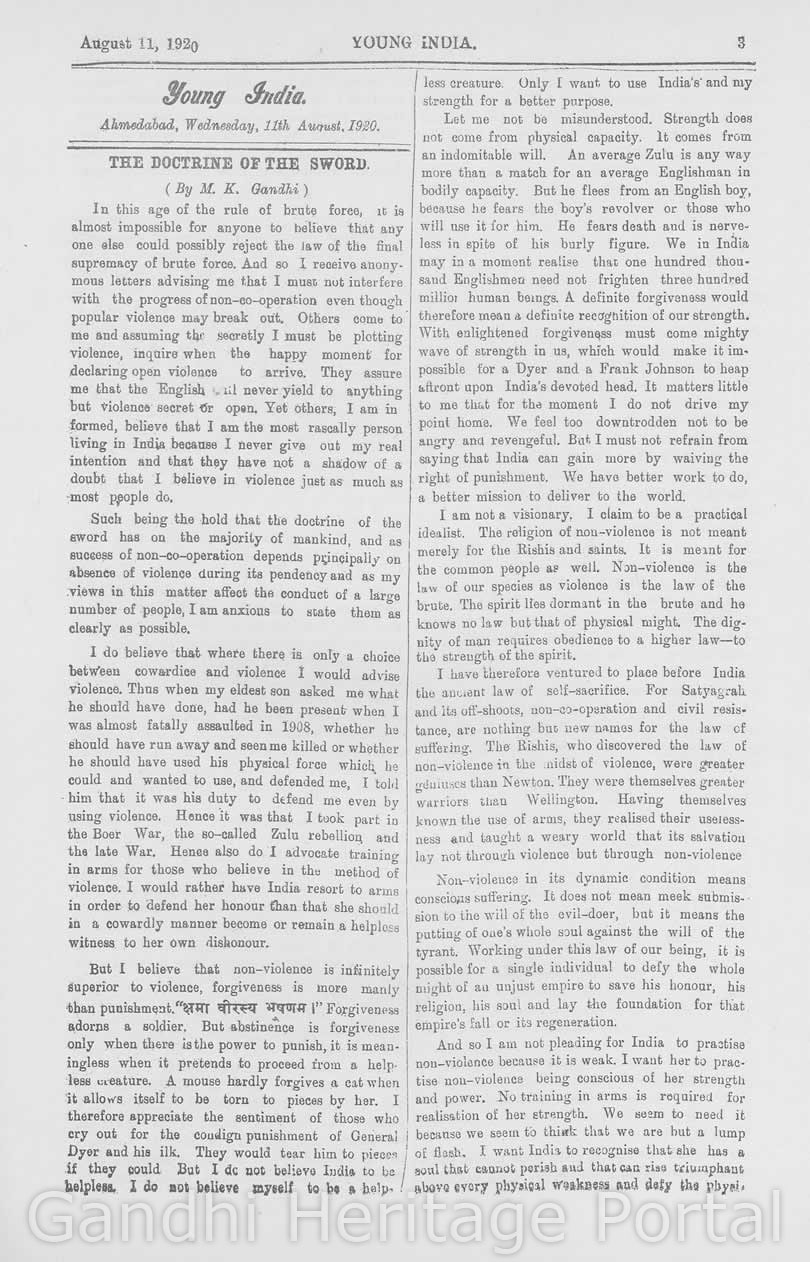
- ^ Gandhi, Mohandis K. The Doctrine of the Sword. Young India (M. K. Gandhi). 1920-08-11: 3 [2017-05-03]. (原始内容存档于2017-10-19). Cited from Borman (1986), pp. 253.
- ^ Devji, Faisal. The Impossible Indian: Gandhi and the Temptation of Violence. Harvard University Press. 2012. [缺少ISBN]
- ^ Johnson (2006),第xi頁.
- ^ 260.0 260.1 Stein, Burton. A History of India. John Wiley & Sons. 2010: 289– [2019-07-21]. ISBN 978-1-4443-2351-1. (原始内容存档于2023-07-21).
Gandhi was the leading genius of the later, and ultimately successful, campaign for India's independence.
- ^ Gupta, Sourabh. Gandhi Jayanti: Why non-violent Mahatma Gandhi preferred violence to cowardice. India Today. 2013-10-02 [2023-08-06]. (原始内容存档于2023-08-06).
- ^ 262.0 262.1 Jahanbegloo, R. Mahatma Gandhi: A Nonviolent Perspective on Peace. Peacemakers. Taylor & Francis. 2020: 69 [2023-08-06]. ISBN 978-1-000-22313-2. (原始内容存档于2023-08-06).
- ^ 263.0 263.1 A. P. Sharma. Indian & Western Educational Philosophy. Pustak Mahal. 2010: 154–56. ISBN 978-81-7806-201-3.
- ^ Winthrop Sargeant. Christopher Key Chapple , 编. The Bhagavad Gita: Twenty-fifth–Anniversary Edition. State University of New York Press. 2010: x–xviii, 285 (verse 6.14), 415 (verse 10.5), 535 (verse 13.7). ISBN 978-1-4384-2840-6. (原始内容存档于2017-04-15).
- ^ Thomas Weber. Gandhi as Disciple and Mentor. Cambridge University Press. 2004: 33. ISBN 978-1-139-45657-9.
- ^ Mahatma Gandhi. An Autobiography: The Story of My Experiments with Truth 39. Beacon Press. 1957: 328 [2016-11-23]. ISBN 978-0-8070-5909-8.
- ^ Sankar Ghose. Mahatma Gandhi. Allied Publishers. 1991: 66–67. ISBN 978-81-7023-205-6.
- ^ 268.0 268.1 Sankar Ghose. Mahatma Gandhi. Allied Publishers. 1991: 354–57. ISBN 978-81-7023-205-6.
- ^ Bhikhu C. Parekh. Colonialism, tradition, and reform: an analysis of Gandhi's political discourse. Sage Publications. 1999: 210–21. ISBN 978-0-7619-9382-7. (原始内容存档于2014-06-29).
- ^ 270.0 270.1 270.2 Jad Adams. Thrill of the chaste: The truth about Gandhi's sex life. The Independent. 2012-01-02. (原始内容存档于2013-06-03).
- ^ 271.0 271.1 Uma Majmudar. Gandhi's Pilgrimage of Faith: From Darkness to Light. State University of New York Press. 2012: 224–25. ISBN 978-0-7914-8351-0.
- ^ Sean Scalmer. Gandhi in the West: The Mahatma and the Rise of Radical Protest. Cambridge University Press. 2011: 12–17 with footnotes. ISBN 978-1-139-49457-1. (原始内容存档于1 January 2016).
- ^ Howard, Veena R. Rethinking Gandhi's celibacy: Ascetic power and women's empowerment. Journal of the American Academy of Religion (Oxford University Press). 2013, 81 (1): 130–61 [130, 137]. doi:10.1093/jaarel/lfs103.
- ^ Alcohol and Temperance in Modern History An International Encyclopedia · Volume 1. ABC-CLIO. 2003: 692.
- ^ M.K. Gandhi as a Author | M.K. Gandhi: Author, Journalist, Printer-Publisher | Journalist Gandhi. www.mkgandhi.org. [2022-01-22]. (原始内容存档于2022-01-25).
- ^ Would Gandhi have been a Wikipedian?. The Indian Express. 2012-01-17 [2012-01-26]. (原始内容存档于2012-12-09).
- ^ "Peerless Communicator" 互联网档案馆的存檔,存档日期2007-08-04. by V. N. Narayanan. Life Positive Plus, October–December 2002.
- ^ Roberts, Andrew. Among the Hagiographers (A book review of "Great Soul: Mahatma Gandhi and His Struggle With India" by Joseph Lelyveld). The Wall Street Journal. 26 March 2011 [2012-01-14]. (原始内容存档于2012-01-03).
- ^ Gandhi, M.K. Unto this Last: A paraphrase. Ahmedabad: Navajivan Publishing House. [2012-07-21]. ISBN 81-7229-076-4. 原始内容存档于2012-10-30.
- ^ Pareku, Bhikhu. Gandhi. Oxford University Press. 2001: 159 [2024-03-29]. ISBN 978-0-19-160667-0. (原始内容存档于2024-03-29).
- ^ M.K. Gandhi. Songs From Prison. Public Resource. 1934.
- ^ Revised edition of Bapu's works to be withdrawn. The Times of India. 2005-11-16 [2012-03-25]. (原始内容存档于2012-10-29).
- ^ Vilanilam, J.V. Mass Communication In India: A Sociological Perspective. SAGE Publications. 2005: 68 [2023-03-17]. ISBN 978-93-5280-570-9. (原始内容存档于2023-03-17).
The greatest of all national leaders (and journalists) of the independence movement was Mahatma Gandhi.
- ^ Parker, Geoffrey. The Times Illustrated History of the World. HarperCollins. 1995: 290 [2023-03-17]. ISBN 978-0-06-270010-0. (原始内容存档于2023-03-17).
The hero of Indian independence from the British, and the greatest figure in decolonization, was Mahatma Gandhi
- ^ Douglas, R. The World War 1939–1945: The Cartoonists' Vision. Routledge Library Editions: WW2. Routledge. 2021: 192 [2023-03-17]. ISBN 978-1-000-46048-3. (原始内容存档于2023-03-17).
Mahatma Gandhi was the most influential of all the Indian politicians in the campaign for independence
- ^ Prashad, G.; Nawani, A. Writings on Nehru: Some Reflections on Indian Thoughts and Related Essays. Northern Book Centre. 2006: 92 [2023-03-17]. ISBN 978-81-7211-204-2. (原始内容存档于2023-02-20).
Mahatma Gandhi was the greatest absorbant [sic] and the greatest personality of modern India
- ^ Blamberger, G.; Kakar, S. Imaginations of Death and the Beyond in India and Europe. Springer Nature Singapore. 2018: 3 [2023-03-17]. ISBN 978-981-10-6707-5. (原始内容存档于2023-02-20).
Mahatma Gandhi, modern India's greatest icon, elevated his search for moksha above any of his social or political goals, including India's freedom from colonial rule.
- ^ Carson, C. The Autobiography of Martin Luther King, Jr.. Grand Central Publishing. 2001: 108 [2023-03-17]. ISBN 978-0-7595-2037-0. (原始内容存档于2023-02-20).
Gandhi is not only the greatest figure in India's history, but his influence is felt in almost every aspect of life and public policy.
- ^ Wolpert (2001),第32–263頁.
- ^ Indira 'woman of millennium', Mahatma 'Asian of century'. Tribune India. 1999-12-02 [2023-03-17]. (原始内容存档于2023-03-17).
- ^ Mahatma Gandhi 'greatest man'. BBC News. 2000 -01-01 [2023-03-17]. (原始内容存档于2023-03-17).
- ^ 292.0 292.1 Mahatma Gandhi Biography. Social Justice & Special Assistance, Government of Maharashtra. [2021-12-21]. (原始内容存档于2022-03-14).
- ^ McGregor, Ronald Stuart. The Oxford Hindi-English Dictionary. Oxford University Press. 1993: 799 [31 August 2013]. ISBN 978-0-19-864339-5.
mahā- (S. 'great, mighty, large, ..., eminent') + ātmā (S. '1. soul, spirit; the self, the individual; the mind, the heart; 2. the ultimate being.'): 'high-souled, of noble nature; a noble or venerable man.'
- ^ Gandhi (2008),第172頁. "...Kasturba would accompany Gandhi on his departure from Cape Town for England in July 1914 en route to India. ... In different South African towns (Pretoria, Cape Town, Bloemfontein, Johannesburg, and the Natal cities of Durban and Verulam), the struggle's martyrs were honoured and the Gandhi's bade farewell. Addresses in Durban and Verulam referred to Gandhi as a 'Mahatma', 'great soul'. He was seen as a great soul because he had taken up the poor's cause. The whites too said good things about Gandhi, who predicted a future for the Empire if it respected justice."
- ^ Charan Shandilya. India-China Relations. Pt. Sunderlal Institute of Asian Studies. : 187.
- ^ Mahatma Gandhi: A Chronology. Ministry of Information and Broadcasting (India). 1971: 60 [2023-03-17]. (原始内容存档于2023-03-17).
- ^ Tagore, Rabindranath. Dutta, Krishna , 编. Rabindranath Tagore: an anthology. Robinson, Andrew. Macmillan. 1998: 2. ISBN 978-0-312-20079-4.
- ^ Guha (2013a), pp. 362, 662. "During my last trip to Europe I saw a great deal of Mr Gandhi. From year to year (I have known him intimately for over twenty years) I have found him getting more and more selfless. He is now leading almost an ascetic sort of life – not the life of an ordinary ascetic that we usually see but that of a great Mahatma and the one idea that engrosses his mind is his motherland."
- ^ Pranjivan Mehta to G. K. Gokhale, dated Rangoon, 8 November 1909, File No. 4, Servants of India Society Papers, NMML.
- ^ Gandhi (1990a),第viii頁.
- ^ Basu Majumdar, A. K. (1993), Rabindranath Tagore: The Poet of India, Indus Publishing, ISBN 81-85182-92-2, p. 83: "When Gandhi returned to India, Rabindranath's eldest brother Dwijendranath, was perhaps the first to address him as Mahatma. Rabindranath followed suit and then the whole of India called him Mahatma Gandhi."
- ^ Ghose (1991),第158頁. "So Tagore differed from many of Gandhi's ideas, but yet he had great regard for him and Tagore was perhaps the first important Indian who called Gandhi a Mahatma. But in 1921 when Gandhi was asked whether he was really a Mahatma Gandhi replied that he did not feel like one, and that, in any event, he could not define a Mahatma for he had never met any."
- ^ Champion of Liberty Issue. Smithsonian National Postal Museum. [2023-12-25]. (原始内容存档于2023-12-27).
- ^ Guha, Ramachandra. India After Gandhi: The History of the World's Largest Democracy. Delhi: Ecco Press. 2007. ISBN 978-0-06-019881-7.
- ^ Stamps on Mahatma Gandhi in 150 countries. India Today. Press Trust of India. 2008-10-02 [2023-03-17]. (原始内容存档于2023-03-17).
- ^ Palestine, Turkey and Uzbekistan Issue Commemorative Gandhi Stamps. The Wire. 2019-10-02 [2023-03-17]. (原始内容存档于-03-17).
- ^ Memorial stamp marking Mahatma Gandhi unveiled in Iran. Islamic Republic News Agency. 2 October 2019 [5 June 2023]. (原始内容存档于17 March 2023).
- ^ Yojana October 2020 (English) (Special Edition): A Development Monthly. Public Division. : 70.
- ^ Chaudhury, Dipanjan Roy. Russia marks 150th year of Mahatma Gandhi with series of events. The Economic Times. 2019 -10-02 [2023-03-17]. (原始内容存档于2023-03-17).
- ^ Moore, Tony. Indian PM Narendra Modi unveils Gandhi statue. Brisbane Times. 2014 -11-16 [2024-04-07]. (原始内容存档于2018 -11-22) (英语).
- ^ Mohandas Karamchand (Mahatma) Gandhi. Monument Australia. [2024-04-07]. (原始内容存档于2024 -04-07).
- ^ King's Trip to India. Mlk-kpp01.stanford.edu. [2012-01-24]. (原始内容存档于200-03-219).
- ^ Sidner, Sara. King moved, as father was, on trip to Gandhi's memorial. CNN. 2009-02-17 [2012-01-24]. (原始内容存档于2012-04-14).
- ^ D'Souza, Placido P. Commemorating Martin Luther King Jr.: Gandhi's influence on King. San Francisco Chronicle. 2003-01-20 [2012-01-24]. (原始内容存档于2013-01-18).
- ^ Tougas, Shelley. Birmingham 1963: How a Photograph Rallied Civil Rights Support. Capstone Press. 2011: 12 [2012-01-24]. ISBN 978-0-7565-4398-3. (原始内容存档于2024-03-29).
- ^ Cone, James. Martin & Malcolm & America: A Dream Or a Nightmare. Orbis Books. 1992. ISBN 0-88344-824-6.
- ^ 317.0 317.1 Mandela, Nelson. The Sacred Warrior. Time. 1999-12-31 [2023-02-20]. ISSN 0040-781X. (原始内容存档于2023-03-07) (美国英语).
- ^ Commemorative Soirée: Relevance of Václav Havel Today. Embassy of the Czech Republic in Delhi. [2022-02-04]. (原始内容存档于2022-02-04).
- ^ Sethi, Rubina. An alternative Gandhi. The Tribune. India. 2004-02-22 [2009-03-12]. (原始内容存档于2009-05-14).
- ^ Bhana, Surendra; Vahed, Goolam H. The Making of a Political Reformer: Gandhi in South Africa, 1893–1914. Manohar. 2005: 44–45, 149. ISBN 978-81-7304-612-4.
- ^ Einstein on Gandhi (Einstein's letter to Gandhi – Courtesy:Saraswati Albano-Müller & Notes by Einstein on Gandhi – Source: The Hebrew University of Jerusalem). Gandhiserve.org. 1931-10-18 [2012-01-24]. (原始内容存档于2012 -01-17).
- ^ Uwechue, Raph. Makers of Modern Africa: Profiles in History. Published by Africa Journal Ltd. for Africa Books Ltd. 1981 [2021-09-05]. ISBN 978-0-903274-14-2. (原始内容存档于2024-03-29).
- ^ Dhupelia-Mesthrie, Uma. Gandhi's prisoner?: the life of Gandhi's son Manilal. Permanent Black. 2005: 293 [2012-01-26]. ISBN 978-81-7824-116-6. (原始内容存档于2024-03-29).
- ^ In the company of Bapu. The Telegraph. 2004-10-03 [2012-01-26]. (原始内容存档于2012-02-08).
- ^ Gilmore, Mikal. Lennon Lives Forever. Rolling Stone. 2005-12-05 [2012-01-24]. (原始内容存档于2007-05-28).
- ^ Applebome, Peter. Applying Gandhi's Ideas to Climate Change. The New York Times. 2008-03-30 [2021-12-02]. (原始内容存档于2021-12-02).
Al Gore cited both Gandhi and Abraham Lincoln in a speech on climate change in 2007. He noted Gandhi's sense of satyagraha ...
- ^ Obama steers clear of politics in school pep talk. MSNBC. Associated Press. 2009-09-08 [2012-01-24]. (原始内容存档于2013-10-04).
- ^ The Children of Gandhi (excerpt). Time. 1999-12-31. (原始内容存档于2013-10-05). 参数
|magazine=与模板{{cite news}}不匹配(建议改用{{cite magazine}}或|newspaper=) (帮助) - ^ Moreno, Jenalia. Houston community celebrates district named for Gandhi. Houston Chronicle. 2010-01-16 [2012-01-24]. (原始内容存档于2015-04-11).
- ^ 330.0 330.1 Mohan, Shaj; Dwivedi, Divya; Nancy, Jean-Luc. Gandhi and Philosophy: On Theological Anti-Politics. Bloomsbury Publishing. 2018 [2024-03-29]. ISBN 978-1-4742-2173-3. (原始内容存档于2024-03-29).
- ^ UN declares 2 October, Gandhi's birthday, as International Day of Nonviolence. UN News Centre. 2007-06-15 [2012-04-02]. (原始内容存档于2012-01-23).
- ^ School Day of Nonviolence And Peace. Letter of Peace addressed to the UN. cartadelapaz.org. 2009-01-30 [2012-01-09]. (原始内容存档于2011-11-01).
- ^ 333.0 333.1 Eulogio Díaz del Corral. DENIP: School Day of Nonviolence and Peace. DENIP. 31 January 1983 [2012-01-30]. (原始内容存档于2012-02-27) (西班牙语).
- ^ Clark, Ronald. Einstein: The Life and Times. A&C Black. 2011. ISBN 978-1-4482-0270-6.
- ^ University and Educational Intelligence (PDF). Current Science. December 1937, 6 (6): 314 [2018-07-15]. (原始内容存档 (PDF)于2018-07-16).
- ^ Peace Laureates – livinghumanity. LivingHumanity. [2024-03-24]. (原始内容存档于2024-03-21).
- ^ Burger, D. South Africa Yearbook 2002/03. Government Communication and Information System. 2002: 99 [2024 -03-24]. ISBN 978-1-919855-14-1. (原始内容存档于2024-03-24).
- ^ Top 25 Political Icons. Time. 2011-02-04 [2011-02-09]. (原始内容存档于2013-12-28). 参数
|magazine=与模板{{cite news}}不匹配(建议改用{{cite magazine}}或|newspaper=) (帮助) - ^ Nobel Peace Prize Nominations. American Friends Service Committee. 2010-04-14 [2012-01-30]. (原始内容存档于2012-02-04).
- ^ 340.0 340.1 Tønnesson, Øyvind. Mahatma Gandhi, the Missing Laureate. Nobel Foundation. 1999-12-01 [2012-01-16]. (原始内容存档于2013-07-05).
- ^ Ghosh, B. N. Contemporary issues in development economics. Psychology Press. 2001: 211. ISBN 978-0-415-25136-5.
- ^ Yardley, Jim. Obama Invokes Gandhi, Whose Ideal Eludes India. The New York Times. 2010-11-06 [2012-01-22]. (原始内容存档于2013-08-17).
- ^ Reserve Bank of India – Bank Notes. Rbi.org.in. [2011-11-05]. (原始内容存档于2011-10-26).
- ^ Chatterjee, Sailen. Martyrs' Day. Features. Press Information Bureau. [2012-01-30]. (原始内容存档于2012-02-02).
- ^ 345.0 345.1 Kaggere, Niranjan. Here, Gandhi is God. BangaloreMirror.com. 2010-10-02 [2011-01-29]. (原始内容存档于2013-10-04).
- ^ Mahatma Gandhi Temple. www.mahatmagandhitemple.org. [2023-02-20]. (原始内容存档于2018-04-14).
- ^ Abram, David; Edwards, Nick. The Rough Guide to South India. Rough Guides. 2003: 506 [2012-01-21]. ISBN 978-1-84353-103-6.


一般參考與引用資料
[编辑]書籍
- Ahmed, Talat (2018). Mohandas Gandhi: Experiments in Civil Disobedience. ISBN 0-7453-3429-6.
- Barr, F. Mary. Bapu: Conversations and Correspondence with Mahatma Gandhi 2nd. Bombay: International Book House. 1956. OCLC 8372568. (see book article)
- Bondurant, Joan Valérie. Conquest of Violence: the Gandhian philosophy of conflict. University of California Press. 1971.[缺少ISBN]
- Borman, William. Gandhi and Non-Violence. State University of New York Press. 1986. ISBN 978-0-88706-331-2.
- Brown, Judith Margaret. Gandhi: Prisoner of Hope. Yale University Press. 1991. ISBN 978-0-300-05125-4.
- Brown, Judith M. (2004). "Gandhi, Mohandas Karamchand [Mahatma Gandhi] (1869–1948)", Oxford Dictionary of National Biography, Oxford University Press.[缺少ISBN]
- Brown, Judith M., and Anthony Parel, eds. (2012). The Cambridge Companion to Gandhi; 14 essays by scholars.[缺少ISBN]
- Chadha, Yogesh. Gandhi: a life. John Wiley. 1997. ISBN 978-0-471-24378-6.
- Dwivedi, Divya; Mohan, Shaj; Nancy, Jean-Luc. Gandhi and Philosophy: On Theological Anti-politics. Bloomsbury Academic, UK. 2019. ISBN 978-1-4742-2173-3.
- Dalton, Dennis. Mahatma Gandhi: Nonviolent Power in Action. Columbia University Press. 2012. ISBN 978-0-231-15959-3.
- Dalton, Dennis. Mahatma Gandhi: Nonviolent Power in Action. Columbia University Press. 2012a. ISBN 978-0-231-53039-2.
- Dhiman, S. Gandhi and Leadership: New Horizons in Exemplary Leadership. Springer. 2016. ISBN 978-1-137-49235-7.
- Easwaran, Eknath. Gandhi the Man: How One Man Changed Himself to Change the World. Nilgiri Press. 2011. ISBN 978-1-58638-055-7.
- Hook, Sue Vander. Mahatma Gandhi: Proponent of Peace. ABDO. 2010. ISBN 978-1-61758-813-6.
- Gandhi, Rajmohan. Patel, A Life. Navajivan Pub. House. 1990.
- Gandhi, Rajmohan. Mohandas: A True Story of a Man, His People, and an Empire. Penguin Books. 2007a. ISBN 978-0-14-310411-7.
- Gandhi, Rajmohan. Mohandas: True Story of a Man, His People, and an Empire. Penguin Books. 2007b. ISBN 978-81-8475-317-2.
- Gandhi, Rajmohan. Gandhi: The Man, His People, and the Empire. University of California Press. 2008. ISBN 978-0-520-25570-8.
- Gangrade, K.D. Role of Shanti Sainiks in the Global Race for Armaments. Moral Lessons From Gandhi's Autobiography And Other Essays. Concept Publishing Company. 2004. ISBN 978-81-8069-084-6.
- Ghose, Sankar. Mahatma Gandhi. Allied Publishers. 1991. ISBN 978-81-7023-205-6.
- Guha, Ramachandra. Gandhi Before India. Vintage Books. 2013. ISBN 978-0-385-53230-3.
- Guha, Ramachandra. Gandhi Before India. Allen Lane. 2013a. ISBN 978-0-670-08387-9.
- Guha, Ramachandra. Gandhi Before India. Penguin Books Limited. 2013x. ISBN 978-93-5118-322-8.
- Guha, Ramachandra. Gandhi before India. Penguin Books Limited. 2014a-10-15 [2021-10-24]. ISBN 978-93-5118-322-8. (原始内容存档于2024-03-29). [查证请求]
- Guha, Ramachandra. Gandhi before India. Vintage Books. 2015. ISBN 978-0-385-53230-3.
- Hardiman, David. Gandhi in His Time and Ours: the global legacy of his ideas. C. Hurst & Co. 2003. ISBN 978-1-85065-711-8.
- Hardiman, David. Gandhi in His Time and Ours: The Global Legacy of His Ideas. Columbia University Press. 2003a [2024-03-29]. ISBN 978-0-231-13114-8. (原始内容存档于2024-03-29).
- Hatt, Christine. Mahatma Gandhi. Evans Brothers. 2002. ISBN 978-0-237-52308-4.
- Herman, Arthur. Gandhi & Churchill: The Epic Rivalry that Destroyed an Empire and Forged Our Age. Random House Publishing Group. 2008. ISBN 978-0-553-90504-5. Ebook: ISBN 978-0-553-80463-8.
- Jai, Janak Raj. Commissions and Omissions by Indian Prime Ministers: 1947–1980. Regency Publications. 1996. ISBN 978-81-86030-23-3.
- Majmudar, Uma. Gandhi's Pilgrimage of Faith: from darkness to light. SUNY Press. 2005. ISBN 978-0-7914-6405-2.
- Markovits, Claude (编). A History of Modern India, 1480–1950. Anthem Press. 2002. ISBN 978-1-84331-004-4.
- McDermott, Rachel Fell; Gordon, Leonard A.; Embree, Ainslie T.; Pritchett, Frances W.; Dalton, Dennis (编). Sources of Indian Traditions, Volume 2: Modern India, Pakistan, and Bangladesh 3rd. New York: Columbia University Press. 2014. ISBN 978-0-231-13830-7.
- Miller, Jake C. Prophets of a just society. Nova Publishers. 2002. ISBN 978-1-59033-068-5.
- Minault, Gail. The Khilafat Movement Religious Symbolism and Political Mobilization in India. Columbia University Press. 1982. ISBN 0-231-05072-0.
- Muldoon, Andrew. Empire, Politics and the Creation of the 1935 India Act: Last Act of the Raj. Routledge. 2016. ISBN 978-1-317-14431-1.
- Pāṇḍeya, Viśva Mohana. Historiography of India's Partition: an analysis of imperialist writings. Atlantic Publishers & Dist. 2003. ISBN 978-81-269-0314-6.
- Pilisuk, Marc; Nagler, Michael N. Peace Movements Worldwide: Players and practices in resistance to war. ABC-CLIO. 2011. ISBN 978-0-313-36482-2.
- Rühe, Peter. Gandhi. Phaidon. 2004. ISBN 978-0-7148-4459-6.
- Schouten, Jan Peter. Jesus as Guru: the image of Christ among Hindus and Christians in India. Rodopi. 2008. ISBN 978-90-420-2443-4.
- Sharp, Gene. Gandhi as a Political Strategist: with essays on ethics and politics. P. Sargent Publishers. 1979. ISBN 978-0-87558-090-6.
- Shashi, S. S. Encyclopaedia Indica: India, Pakistan, Bangladesh. Anmol Publications. 1996. ISBN 978-81-7041-859-7.
- Sinha, Satya. The Dialectic of God: The Theosophical Views Of Tagore and Gandhi. Partridge Publishing India. 2015. ISBN 978-1-4828-4748-2.
- Sofri, Gianni. Gandhi and India: a century in focus. Windrush Press. 1999. ISBN 978-1-900624-12-1.
- Thacker, Dhirubhai. Gandhi, Mohandas Karamchand. Amaresh Datta (编). The Encyclopaedia of Indian Literature (Volume Two) (Devraj To Jyoti). Sahitya Akademi. 2006: 1345. ISBN 978-81-260-1194-0.
- Todd, Anne M. Mohandas Gandhi. Infobase Publishing. 2004. ISBN 978-0-7910-7864-8.; short biography for children
- Todd, Anne M. Mohandas Gandhi. Infobase Publishing. 2009. ISBN 978-1-4381-0662-5.
- Wolpert, Stanley. Gandhi's Passion: The Life and Legacy of Mahatma Gandhi. Oxford University Press. 2001 [2017-06-03]. ISBN 978-0-19-515634-8. (原始内容存档于2023-07-21).
- Wolpert, Stanley. Midnight in Calcutta. Gandhi's Passion: The life and legacy of Mahatma Gandhi. Oxford University Press. 2001a [2023-02-20]. ISBN 0-19-515634-X. (原始内容存档于2016-03-21).
- Wolpert, Stanley. Gandhi's Passion: the life and legacy of Mahatma Gandhi. Oxford University Press. 2002. ISBN 978-0-19-972872-5.
- Wolpert, Stanley. Gandhi's Passion: The Life and Legacy of Mahatma Gandhi. Oxford University Press. 2002a. ISBN 978-0-19-515634-8. (原始内容存档于19 February 2017).
- Wolpert, Stanley. A New History of India 7th. New York: Oxford University Press. 2004. ISBN 0195166787.
- Wolpert, Stanley. Shameful Flight: The Last Years of the British Empire in India. Oxford University Press. 2009. ISBN 978-0-19-539394-1. (原始内容存档于1 October 2013).
學術文章
- Danielson, Leilah C. "'In My Extremity I Turned to Gandhi': American Pacifists, Christianity, and Gandhian Nonviolence, 1915–1941". Church History 72.2 (2003): 361–388.
- Du Toit, Brian M. "The Mahatma Gandhi and South Africa." Journal of Modern African Studies 34#4 (1996): 643–660. .
- Gokhale, B. G. "Gandhi and the British Empire", History Today (Nov 1969), 19#11 pp 744–751 online.
- Juergensmeyer, Mark. "The Gandhi Revival – A Review Article." The Journal of Asian Studies 43#2 (Feb. 1984), pp. 293–298.
- Khosla, G.D. The Murder of the Mahatma (proceedings by the Chief Justice of Punjab) (PDF). Jaico Publishers. 1965. (原始内容 (PDF)存档于21 September 2015).
- Kishwar, Madhu. "Gandhi on Women." Economic and Political Weekly 20, no. 41 (1985): 1753–758. .
- Mohammed, Fevin "Gandhi the Great". (2013) (PhD in Historical Research, Coordinated under Prof. Ram Prasad Sharma).
- Murthy, C. S. H. N., Oinam Bedajit Meitei, and Dapkupar Tariang. "The Tale Of Gandhi Through The Lens: An Inter-Textual Analytical Study Of Three Major Films-Gandhi, The Making Of The Mahatma, And Gandhi, My Father." CINEJ Cinema Journal 2.2 (2013): 4–37. online
- Power, Paul F. "Toward a Revaluation of Gandhi's Political Thought." Western Political Quarterly 16.1 (1963): 99–108 excerpt.
- Rudolph, Lloyd I. "Gandhi in the Mind of America." Economic and Political Weekly 45, no. 47 (2010): 23–26. .
主要資料來源
- Abel M. Glimpses of Indian National Movement. ICFAI Books. 2005. ISBN 978-81-7881-420-9.
- Andrews, C. F. VII – The Teaching of Ahimsa. Mahatma Gandhi's Ideas Including Selections from His Writings. Pierides Press. 2008 [1930]. ISBN 978-1-4437-3309-0.
- Dalton, Dennis (编). Mahatma Gandhi: Selected Political Writings. Hackett Publishing. 1996. ISBN 978-0-87220-330-3.
- Duncan, Ronald (编). Selected Writings of Mahatma Gandhi. Literary Licensing, LLC. 2011 [4 September 2017]. ISBN 978-1-258-00907-6. (原始内容存档于1 October 2020).
- Gandhi, Mohandas Karamchand. Satyagraha in South Africa. 由Valji G. Desai翻译 1st. Ahmedabad: Navajivan Publishing House. 1928 (古吉拉特语).
- Gandhi, Mohandas Karamchand. The Collected Works of Mahatma Gandhi. Publications Division, Ministry of Information and Broadcasting, Govt. of India. 1994. ISBN 978-81-230-0239-2. (100 volumes). Free online access from Gandhiserve.
- Gandhi, Mohandas Karamchand. Drain Inspector's Report. The United States of India. 1928, 5 (6–8): 3–4.
- Gandhi, Mohandas Karamchand. Desai, Mahadev H. , 编. Autobiography: The Story of My Experiments With Truth. Mineola, N.Y.: Dover. 1990a. ISBN 0-486-24593-4.
- Gandhi, Mohandas Karamchand. Fischer, Louis , 编. The Essential Gandhi: An Anthology of His Writings on His Life, Work and Ideas 2nd. Vintage Books. 2002. ISBN 978-1-4000-3050-7.
- Jack, Homer A. (编). The Gandhi Reader: A Source Book of His Life and Writings. Grove Press. 1994. ISBN 978-0-8021-3161-4.
- Johnson, Richard L. (编). Gandhi's Experiments with Truth: Essential Writings by and about Mahatma Gandhi. Lexington Books. 2006. ISBN 978-0-7391-1143-7.
- Parel, Anthony J. (编). Gandhi: "Hind Swaraj" and Other Writings Centenary Edition. Cambridge University Press. 2009. ISBN 978-0-521-14602-9.
外部連結
[编辑]


- Gandhi's correspondence with the Indian government 1942–1944
- About Mahatma Gandhi
- Gandhi at Sabarmati Ashram
- Mahatma Gandhi的作品 - 古騰堡計劃
- 互联网档案馆中圣雄甘地的作品或与之相关的作品
 來自圣雄甘地的LibriVox公共領域有聲讀物
- 有关圣雄甘地在德国经济学中央图书馆(ZBW)20世纪新闻档案中的剪报。